

If your parent is struggling to get in and out of bed safely, you are probably Googling 'bed rail for seniors' and seeing two very different products show up side by side. One is a short assist bar that tucks under the mattress and gives a sturdy grip point. The other is a full-length guard that runs half the length of the bed and looks like it keeps someone from rolling off. They look like versions of the same product. They are not.
I am Pamela. I have managed a medical office for over 20 years, and I have also been my own mother's primary caregiver for the past three years. I have seen the difference between these two products play out in real bedrooms, not just on Amazon pages. The short answer: if your parent is mobile and needs help getting up, get the assist bar. If you are considering a full-length guard for fall prevention while sleeping, there is something important you need to know about entrapment risk before you buy.
| attribute | left | right | |
| attribute | left | right | winner |
| attribute | left | right | winner |
| attribute | left | right | winner |
| attribute | left | right | winner |
| attribute | left | right | winner |
| attribute | left | right | winner |
| attribute | left | right | winner |
| attribute | left | right | winner |
| attribute | left | right | winner |
Where the Medline Bed Assist Bar Wins
My mother is 81, has mild balance issues and arthritis in both hands, and was waking up twice a night to use the bathroom. The thing that was wearing both of us down was not the bathroom trips themselves. It was the getting-up-from-the-mattress part. A bed that felt fine at 60 becomes a project at 81. The Medline assist bar solved this in a way that nothing else we tried did. It gave her a solid, non-wobbly handle at exactly the right height to push from, and she regained the independence to get up without waking me.
The bar is height adjustable, which matters more than it sounds. Most beds, once you factor in the mattress depth, are not at the same height. My mother's king-size mattress sits at a different height than her guest bed. The Medline bar has multiple notches and adjusted in about 30 seconds without any tools. Installation itself took under five minutes. The support plate slides under the mattress and the weight of the mattress holds it in place. No hardware, no drilling, no assembly required. That matters at 11 pm when you are trying to solve a problem, not complete a project.
The storage pocket on the side is genuinely useful. My mother keeps her glasses, her phone, and her call-button device in it. Everything she needs at 2 am is right there without her having to reach across the nightstand. That is a real fall-prevention feature that rarely gets mentioned in product descriptions.
Structurally, the bar is solid. We are now 11 months in. She uses it every night, sometimes leaning her full weight on it. No wobble, no signs of wear on the metal. The grip padding on the handle held up too. At the current price, this is genuinely one of the best-value safety products I have recommended to patients' families.
If your parent needs leverage to get up, this is the one that actually delivers it.
The Medline Bed Assist Bar has 15,000+ reviews, installs in under five minutes, and includes a storage pocket for nightstand essentials. It is what I use for my own mother.
Amazon Check Today's Price on Amazon →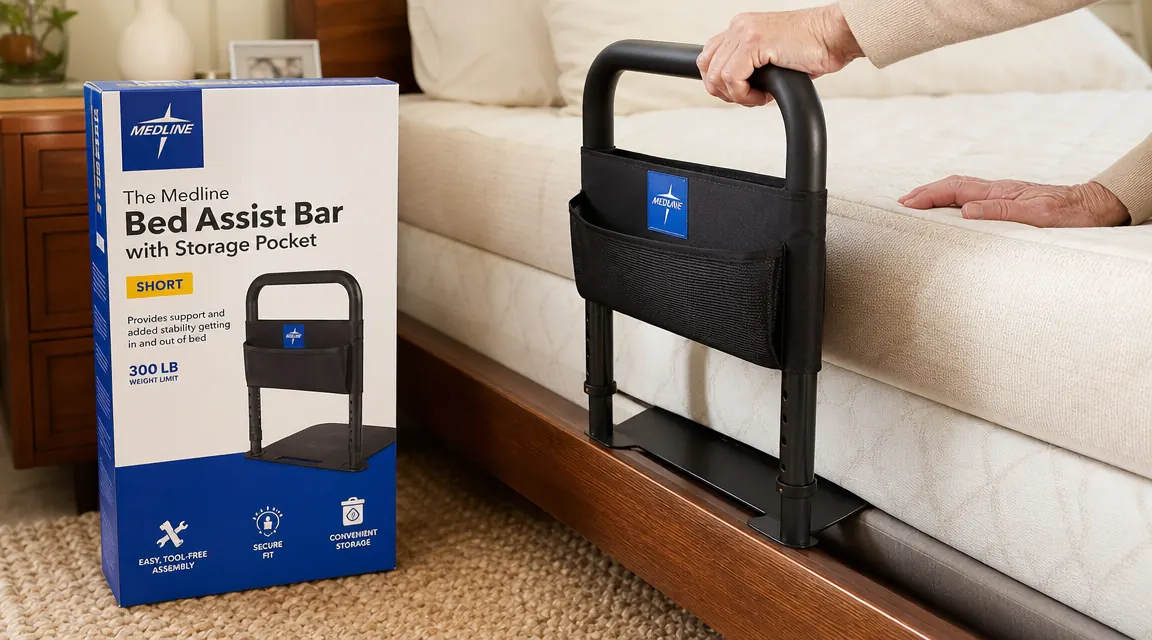
The Entrapment Risk Nobody Talks About With Full-Length Guards
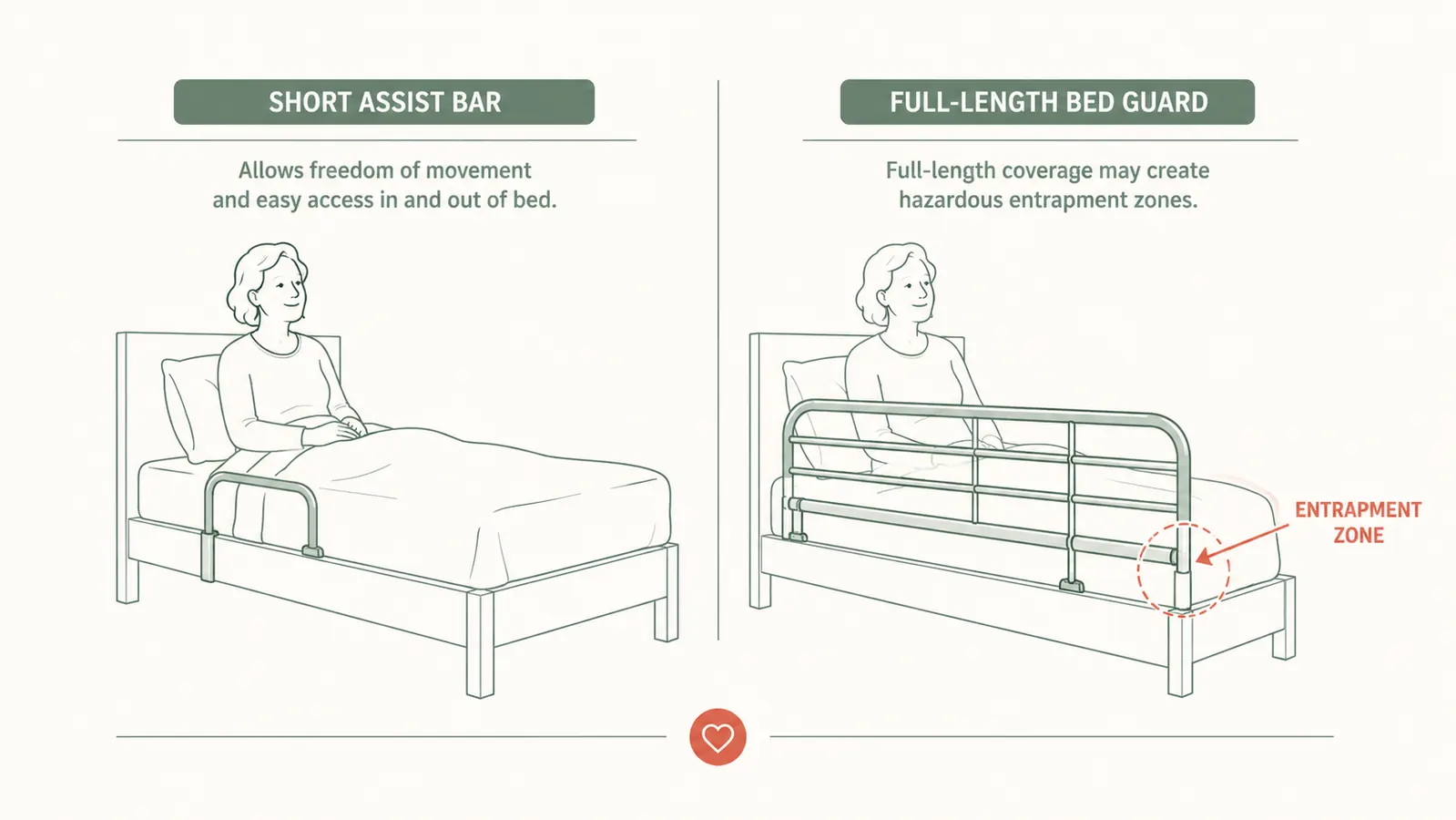
Here is the thing I need you to know before you buy a full-length bed guard for a senior. The FDA has issued multiple safety advisories about entrapment in adult portable bed rails. When a full-length guard creates a barrier along the side of a bed, it also creates a gap between the rail and the mattress. For a person who rolls toward the edge in their sleep, that gap can trap a limb, a neck, or in the worst documented cases, lead to suffocation. This is not a fringe concern. The FDA identified 155 deaths linked to entrapment in portable bed rails between 2003 and 2012, with the vast majority involving older adults.
Full-length guards have a legitimate clinical use. In hospital and skilled nursing settings, they are used under close supervision for patients who are fully bed-bound, who have cognitive impairment that makes them unaware of the rail, or who have specific fall-from-bed diagnoses. In those settings, a trained nurse does rounds. At home, nobody is doing rounds at 3 am. The risk profile is genuinely different.
A full-length guard built to stop someone from rolling out can also trap someone trying to get out. For a mobile senior, that is the wrong tradeoff.
If your parent is mobile enough to get up on their own, a full-length guard is likely the wrong product. It may feel like more protection because it covers more of the bed, but more coverage does not mean more safety for someone who is still moving around. A short assist bar that helps them get up confidently prevents a fall during the highest-risk moment of the night: the transition from lying down to standing. That is when most nighttime falls happen. Not mid-sleep. At exit.
Where a Full-Length Guard Has a Place
I want to be fair here. Full-length bed guards are not without purpose. If your parent is in the later stages of dementia and is no longer initiating independent transfers, a full-length guard can serve as a physical reminder and a soft barrier that reduces rolling-out events during sleep. The key phrase is 'no longer initiating independent transfers.' If they are getting up on their own at night, even sometimes, a full-length guard creates more problems than it solves.
In that lower-mobility scenario, I would still strongly recommend choosing a model that is compliant with the current Consumer Product Safety Improvement Act standards for adult portable bed rails, checking for any gap between the rail and the mattress with a 4-inch sphere test, and speaking with a physical or occupational therapist before making the call. This is one of those products where the right answer genuinely depends on the individual's mobility level, and it is worth a ten-minute consultation.

Who Should Buy Which
Buy the Medline Bed Assist Bar if your parent can get up independently but struggles with the push-to-stand from a soft mattress. If they are waking up multiple times a night to use the bathroom, if their grip strength or balance has declined, or if they have had one close call getting out of bed, this is the right product. It gives them the independence to move safely without creating a barrier that traps them.
Consider a full-length guard only if your parent is no longer initiating independent transfers, is bed-bound for most of the day, has advanced cognitive decline, or is in a setting with regular supervision. In most home caregiving situations for a mobile senior, the assist bar is the safer and more practical choice. The goal is to keep them moving safely, not to keep them in the bed.
If you are not sure which category your parent falls into, watch them get out of bed once. If they can get their legs to the floor and push to standing, even slowly, they are mobile enough that the assist bar serves them better. If they cannot initiate that movement at all, the full-length conversation is worth having with their doctor.
For more detail on the Medline bar itself, including 11 months of real use data on our king-size bed, read the full long-term review linked below. And if you want the broader picture on nighttime bed safety for aging parents, the step-by-step fall prevention guide covers mattress height, lighting, medication side effects, and everything else that goes into keeping a senior safe at night.
Internal: see also Medline Bed Assist Bar: 11 Months of Nightly Use and How to Prevent an Elderly Parent from Falling Out of Bed.
For most mobile seniors, the assist bar is the safer, smarter choice.
The Medline Bed Assist Bar installs in minutes, adjusts to any bed height, and gives your parent the grip they need to get up safely without creating entrapment risk. Over 15,000 families are using it.
Amazon Check Today's Price on Amazon →