

March of last year, my mother Dorothy fell in the driveway reaching for the car door. She is 82, lives alone two miles from me, and until that morning she had resisted every mobility aid I brought up. The fall did not break anything, but it broke her confidence. Within a week she agreed to try a walker. Within two weeks we had the Drive Medical Rollator Walker in her hallway. That was 14 months ago. She uses it every single day, inside and outside, in the kitchen, in the parking lot of the grocery store, on her morning lap around the block. I have watched it through every season, every errand, and a handful of near-misses that reminded me exactly why we got it. This is the honest long-term report.
I want to say up front: I am a medical office manager with 22 years in healthcare. I see home medical equipment come back from patients all the time, hear which products hold up and which end up in closets. The Drive Medical rollator is one of the most-prescribed walkers we see in our practice. That track record is part of why I chose it for Dorothy. What I did not fully appreciate until living with it was the difference between knowing a product clinically and knowing it as a caregiver.
The Quick Verdict
Solidly built, height-adjustable, genuinely comfortable seat, and 50,000 reviewers cannot all be wrong. A minor annoyance with the loop brake cable is the only real wear issue we have seen in 14 months of daily use.
Amazon Check Today's Price →Still researching which rollator to get? Dorothy uses this one every day and it has held up for over a year.
The Drive Medical Rollator Walker is currently one of the most popular mobility aids on Amazon with a 4.6-star average across more than 50,000 reviews. Check today's price and see if it ships to your zip code.
Amazon Check Today's Price on Amazon →How I Have Used It for 14 Months
Dorothy is 5 feet 2 inches, 128 pounds, with moderate osteoarthritis in both knees and mild balance issues after a 2023 inner ear infection that was never fully resolved. She does not need continuous support, but she needs something to catch her on the seconds when the ground feels uncertain. That is exactly the use case a rollator is designed for, and it is different from what a standard walker is designed for. I want to be precise about that because I see families buy the wrong one all the time.
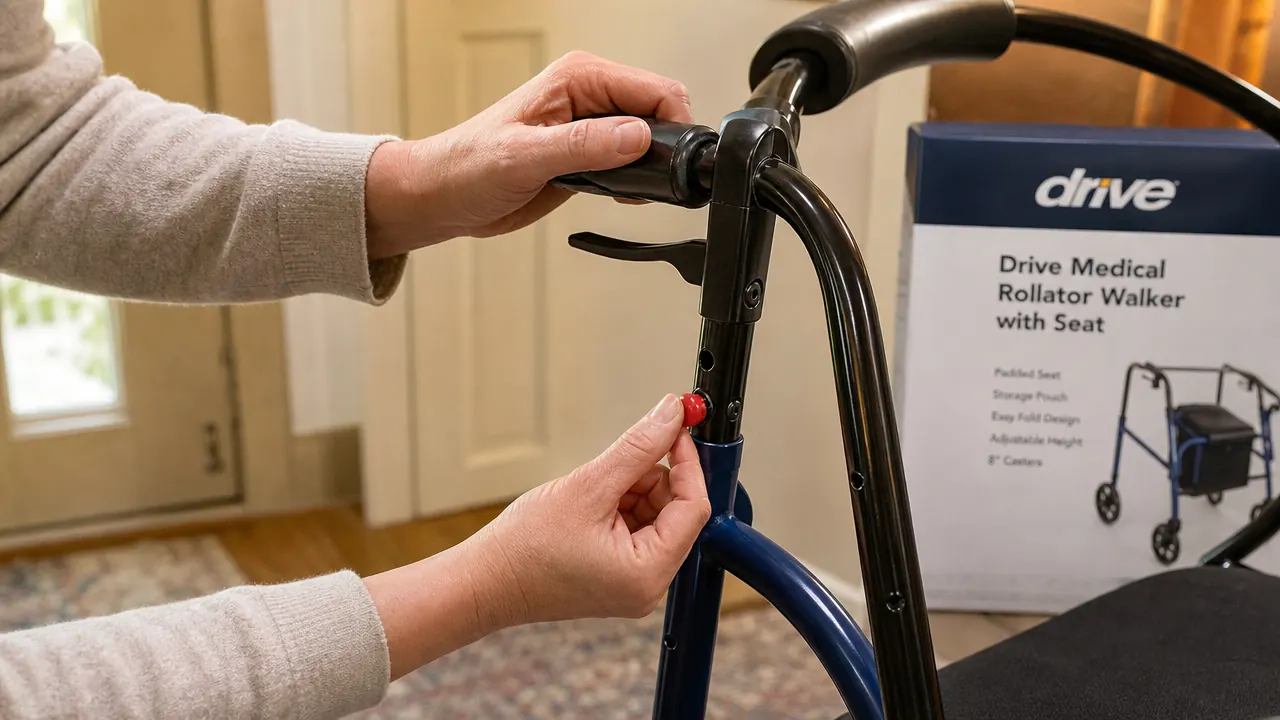
During the first month I adjusted the handlebar height twice before landing on the right setting for her posture. The height-adjustment mechanism is a simple push-pin on each side, and it clicks into place reliably. We settled at the fourth notch from the bottom, which put her elbows at a comfortable slight bend with her shoulders relaxed. That setup has not moved in over a year. She does her morning walk, she parks the rollator beside her kitchen chair, she uses it to lower herself onto the couch. It is load-bearing several times a day.
Over summer we took it to a family reunion at a state park with uneven grass paths. Over fall we used it on wet pavement after rain. Over winter it went through a long stretch of mall-walking when the sidewalks were icy. Each environment gave me something new to observe. I will cover each one below.
What the 6-Inch Wheels Actually Do on Different Surfaces
The Drive Medical rollator ships with 6-inch wheels, which are on the smaller side compared to some models that go up to 8 inches. On smooth indoor floors, tile, and packed sidewalk, the 6-inch wheels are completely fine. They roll quietly, turn easily, and do not catch on standard door thresholds. Dorothy's kitchen has a quarter-inch lip between the tile and the hardwood, and the wheels cross it without drama.
On uneven outdoor surfaces the smaller wheels show their limits. At the state park reunion, Dorothy needed a steadying hand on a short stretch of bumpy grass. The wheels caught on the turf a couple of times and required a small lift to continue. This is not a failure of the product, it is the physics of a 6-inch wheel. If your parent primarily uses their rollator outdoors on varied terrain, I would look at the Drive Medical models with 8-inch wheels. For Dorothy's primary use of indoor movement plus paved outdoor walking, the 6-inch wheels are entirely adequate and we have never felt unsafe.
The rollator did not give Dorothy her old gait back. It gave her the confidence to keep moving. For an 82-year-old with balance issues, that is the whole game.
The Seat: Better Than I Expected, With One Honest Caveat
I underestimated how much Dorothy would use the seat. Within the first two weeks I realized she was sitting on it at the grocery store to inspect items on lower shelves, sitting at the park when she needed a rest, and occasionally using it as a perch in the kitchen while she waited for the kettle. The seat is padded, about 11 inches wide, and sits at a height she can stand from without excessive effort. After 14 months the padding has compressed slightly but is still comfortable for sitting in 5-to-10 minute stretches.
The caveat: the seat does not lock into a perfectly rigid position, and if Dorothy sits toward the very front edge at an angle, the seat flexes slightly. It does not feel unsafe, but if your parent is heavier or has difficulty with weight distribution while sitting, I would want you to know that before buying. The rollator is rated to 300 pounds, which is a robust capacity. But the seat flex is something to account for if sitting stability is a concern.
The Brakes: How They Work and the One Issue We Had
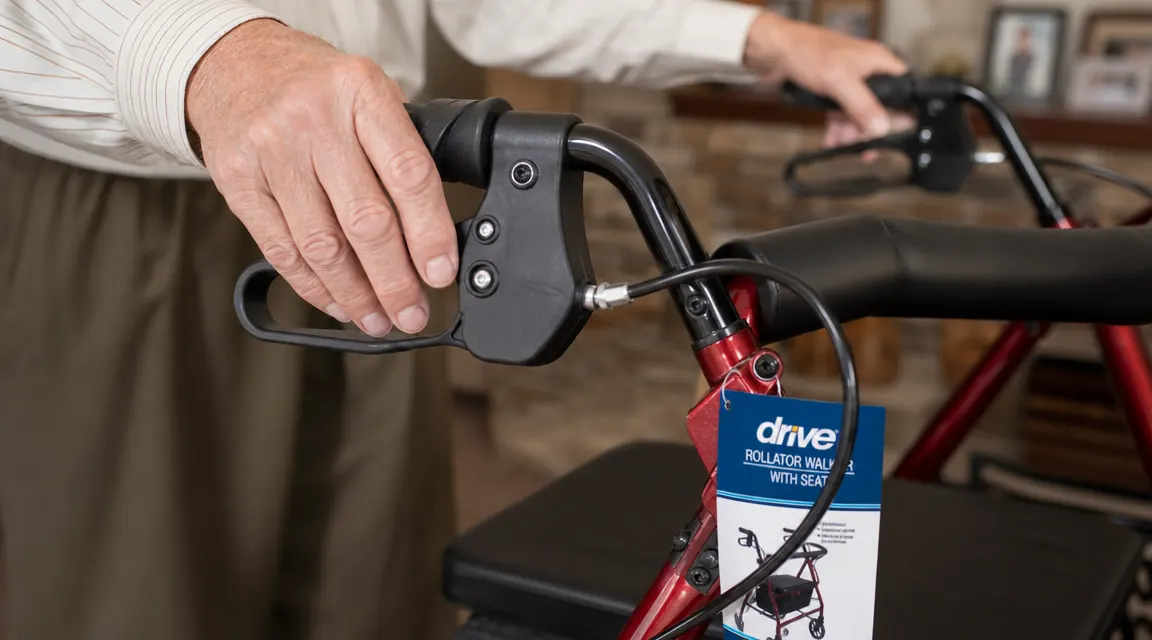
This rollator uses loop cable brakes, the same design you see on bicycles. You squeeze the handles to slow the wheels, and you press down on the handle locks to engage the parking brake when sitting or stopping. In clinical settings I have seen patients struggle with lever-style brakes because the motion is counterintuitive. The loop design is more natural for older hands, and Dorothy figured it out on the first walk.
At month nine, I noticed one of the cable housing caps had worked itself loose, which caused a small amount of cable slack and made the left brake feel slightly softer than the right. It took me about four minutes to push the housing cap back into its collar and retighten the adjustment screw. After that, the brakes were back to normal. I am mentioning this not because it is a serious flaw but because if you are a caregiver who is not mechanically inclined, it is worth knowing that a minor cable check at the six-to-twelve-month mark is a good idea. Think of it the way you think of checking tire pressure. Not an emergency, just maintenance.
Assembly, Folding, and the Car Trunk Question
Assembly out of the box took me about 20 minutes. The instructions are functional but not beautiful. The main steps are attaching the seat backrest strap, inserting the handlebar posts, and attaching the wheels. No tools required beyond the included Allen wrench. If you have assembled any piece of flat-pack furniture you will find this easier. The finished product feels solid, not rattly.
The rollator folds by lifting the seat from the front edge, which brings the two sides together into a flat collapsed form. The folded width is about 11 inches, which fits in a standard car trunk alongside grocery bags. Dorothy and I have gotten into a routine where she walks to the car, I fold the rollator in about 8 seconds, drop it in the trunk, and we go. Coming home I reverse the process. She tells me it is easier than her previous cane because she does not have to hold the cane while getting in and out of the car seat.
What I Liked
- 14 months of daily use and the frame shows no bending, cracking, or joint wear
- Height adjustment is fast and clicks into place firmly, no slipping over time
- Seat is genuinely useful, not just a marketing feature, Dorothy sits on it multiple times daily
- Loop cable brakes are intuitive for older hands and require minimal grip strength
- Folds flat for car trunk in under 10 seconds once you have done it a few times
- 300-pound weight capacity gives a meaningful safety margin for most users
- Under-seat bag provides real storage for a wallet, phone, and a folded jacket
Where It Falls Short
- 6-inch wheels limit performance on uneven grass, gravel, and packed dirt terrain
- Cable housing can loosen over months and requires a simple but real maintenance check
- Seat flexes slightly if user sits at an off-center angle, notable for users who need rigid sitting support
- Assembly instructions are sparse and some photos are low-resolution

The Under-Seat Storage Bag
This is the feature nobody mentions first and the one Dorothy talks about most. The rollator comes with a zippered fabric bag that hangs beneath the seat. She carries her phone, her house keys, a folded shopping list, and a small coin purse. Before the rollator she used to leave things on counters because carrying a bag while using a cane was awkward. Now she is consistently walking out of the house with everything she needs. From a caregiver perspective, the storage bag has reduced a surprising number of the small daily inconveniences that accumulate into caregiver burden.
Who This Is For
This rollator is the right choice for an older adult who has balance uncertainty rather than a complete inability to bear their own weight, who walks on a mix of indoor and smooth outdoor surfaces, who would benefit from an occasional sit-down during longer outings, and who has enough hand strength to operate loop-style cable brakes. Dorothy checks all four boxes, and after 14 months I would choose this product again without hesitation. At this price point and with this track record, it is one of the most straightforward recommendations I make.
Who Should Skip It
If your parent needs a walker primarily for rough outdoor terrain, hilly ground, or paths that are not paved, look at a rollator with 8-inch wheels or an all-terrain model. If your parent needs a walking aid primarily because they cannot bear their own weight, a standard walker with no wheels may provide more stability since a rollator is designed to roll with you, not hold you up at a standstill. If your parent cannot reliably engage a brake before sitting down, you may want a rollator with a seat that locks more firmly into position. These are clinical distinctions I make as part of my job, and I think caregivers deserve to hear them plainly rather than in fine print.
If none of those exceptions apply, you are probably in exactly the market for this product. The Drive Medical rollator is not a luxury item. It is a well-designed, durable, everyday mobility aid that has held up under real daily use for 14 months and counting. I check the cable tension twice a year the way I check the smoke detector batteries. Everything else has required nothing from me except letting Dorothy use it.
For more on how this compares to a standard four-point walker, see our rollator vs standard walker breakdown. And if you are still deciding whether a rollator is the right category of aid for your parent, our piece on 10 reasons a rollator helps seniors stay independent longer walks through the specific functional benefits in plain terms.
Dorothy still walks with this every morning. If your parent is where she was 14 months ago, this is where I would start.
The Drive Medical Rollator Walker has a 4.6-star rating from over 50,000 Amazon buyers. It is the same model that occupational therapists and physical therapists recommend most. Click below to see today's price and current availability.
Amazon Check Today's Price on Amazon →