

My mother, Eleanor, is 79 years old, 118 pounds, and has slept in the same king-size bed since 1987. She was not going to let me raise her bed frame, replace her pillow-top mattress, or rearrange her bedroom. What she would let me do, after her second near-miss getting up to use the bathroom at 2am, was try a bed assist bar. That was eleven months ago. The bar is still there, still tight, and I have not gotten a 3am phone call since.
I want to be upfront about something: I work in a medical office, so I have watched physicians recommend bed rails and I have also seen the paperwork when they do not work as expected. I came into this purchase with a clinical skeptic's eye, not a hopeful daughter's. What I found is that the Medline Bed Assist Bar is genuinely well-engineered for what it is, has two real limitations worth knowing about, and is probably the right answer for about 80 percent of caregiver situations I can describe.
The Quick Verdict
A sturdy, fast-installing assist bar that holds its position on most mattress types , the right buy for seniors who need getting-in and getting-out support, not a fall-prevention containment rail.
Amazon Check Today's Price →If Mom is having trouble getting up at night, this is the first thing I would try.
The Medline Bed Assist Bar installs in under ten minutes, fits king through twin beds, and has 15,000 reviews from caregivers in situations similar to yours. Check the current price on Amazon before you spend another night worrying.
Amazon Check Today's Price on Amazon →How I've Used It: 11 Months on a King Pillow-Top
Mom's bedroom setup is not the ideal test case for a bed assist bar. King mattresses are wide, which means the rail base plate has to span a significant distance from the center of the mattress to the edge where she grips it. Her pillow-top adds about four extra inches of compressible foam on top of the standard mattress depth. And she gets up, on average, twice a night because of the Lasix she takes for mild congestive heart failure. That pill works, which means the bathroom trips are non-negotiable.
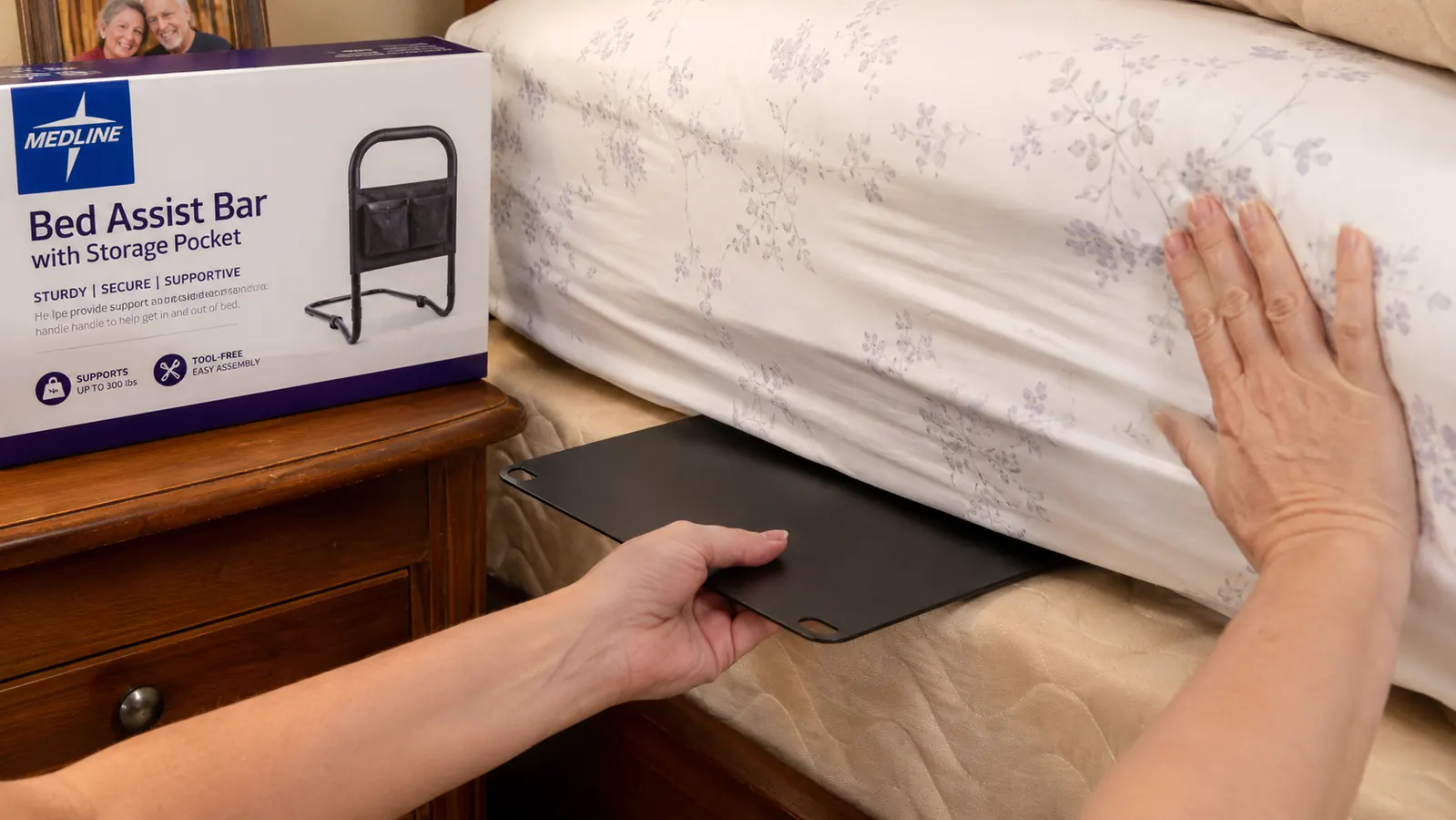
I installed the bar the first evening I brought it home. I slid the flat steel base plate between her mattress and box spring, centered it about two-thirds of the way down from the head of the bed so the grip handle sits right where her hand naturally falls when she rolls to sit up. Total time: seven minutes, including reading the instruction sheet. I checked the lateral wobble by pushing the top of the rail side-to-side. On a firm queen, that test produces almost no movement. On Mom's pillow-top king, I got about a half-inch of lateral movement under hard sideways force, which sounds alarming but in practice means nothing. She uses it as a vertical push-up assist, not a lateral lean. The vertical stability is solid.
I went back at the one-month mark and retightened the under-mattress strap. The pillow-top had compressed slightly around the base plate and introduced a small amount of additional wobble. After that one adjustment, I have not had to touch it. At the six-month mark I checked every weld point and found no cracking or stress marks. At eleven months, same story. The powder-coat finish has one small chip near the bottom of the upright where Mom bumped it with her cane, but that is cosmetic.
What the Medline Bar Actually Is (and Is Not)
This is an assist bar, not a guard rail. That distinction matters clinically. A guard rail runs the full length of the bed and is designed to prevent a sleeping person from rolling out. An assist bar is positioned at the edge near the head or mid-bed and is designed to give a seated or semi-recumbent person something to push off of when rising, and something to lower themselves against when lying down. If your parent is falling out of bed in their sleep, this is not the product. If your parent is struggling to get up without waking you or risking a fall during the transition from lying to standing, this is exactly the product.
The frame is steel, not aluminum. It weighs about 4.5 pounds. The grip handle is coated in a soft non-slip material that Mom says is comfortable even in the middle of the night when her hands are stiff. The handle height is adjustable across several positions, which I used to lower it slightly from the default so that when she grips it from a seated position her elbow bends at roughly 90 degrees. That is the ergonomically correct position for a push-up assist, and it is worth spending two minutes dialing in.
The grip height adjustment took me ninety seconds. It is the one thing I wish every caregiver knew to do before the first use.
Installation Specifics: King Beds, Pillow-Tops, and Adjustable Frames
For a standard king or queen on a box spring, installation is genuinely as simple as the box claims. The base plate goes under the mattress, you run the strap over the top of the mattress edge, and the compression of the mattress holds everything in place. On a pillow-top, I recommend going a little further under the mattress with the base plate, past where the pillow-top padding starts, so you get contact with the firmer core of the mattress. That is the adjustment that eliminated most of the wobble on Mom's bed.
For adjustable beds, the answer is more complicated. The base plate design assumes a static mattress sitting on a fixed surface. If the head or foot of the bed moves, the geometry shifts and the plate can migrate. Medline does make a version specifically engineered for adjustable frames, but it is not this one. If your parent has a Sleep Number or similar adjustable bed, do not buy this bar without confirming that configuration is supported. I have seen this mismatch cause problems in my practice.
Beds with no box spring, such as platform beds or memory-foam-on-a-slatted-frame, depend on total mattress thickness for clamping force. Most memory foam mattresses are thick enough that this is fine. Mattresses under about 8 inches may not provide enough compression to hold the base plate securely. Check your mattress depth against Medline's listed range, which is 7 to 13 inches, before ordering.
Real Night-Use: What Mom Says After 11 Months
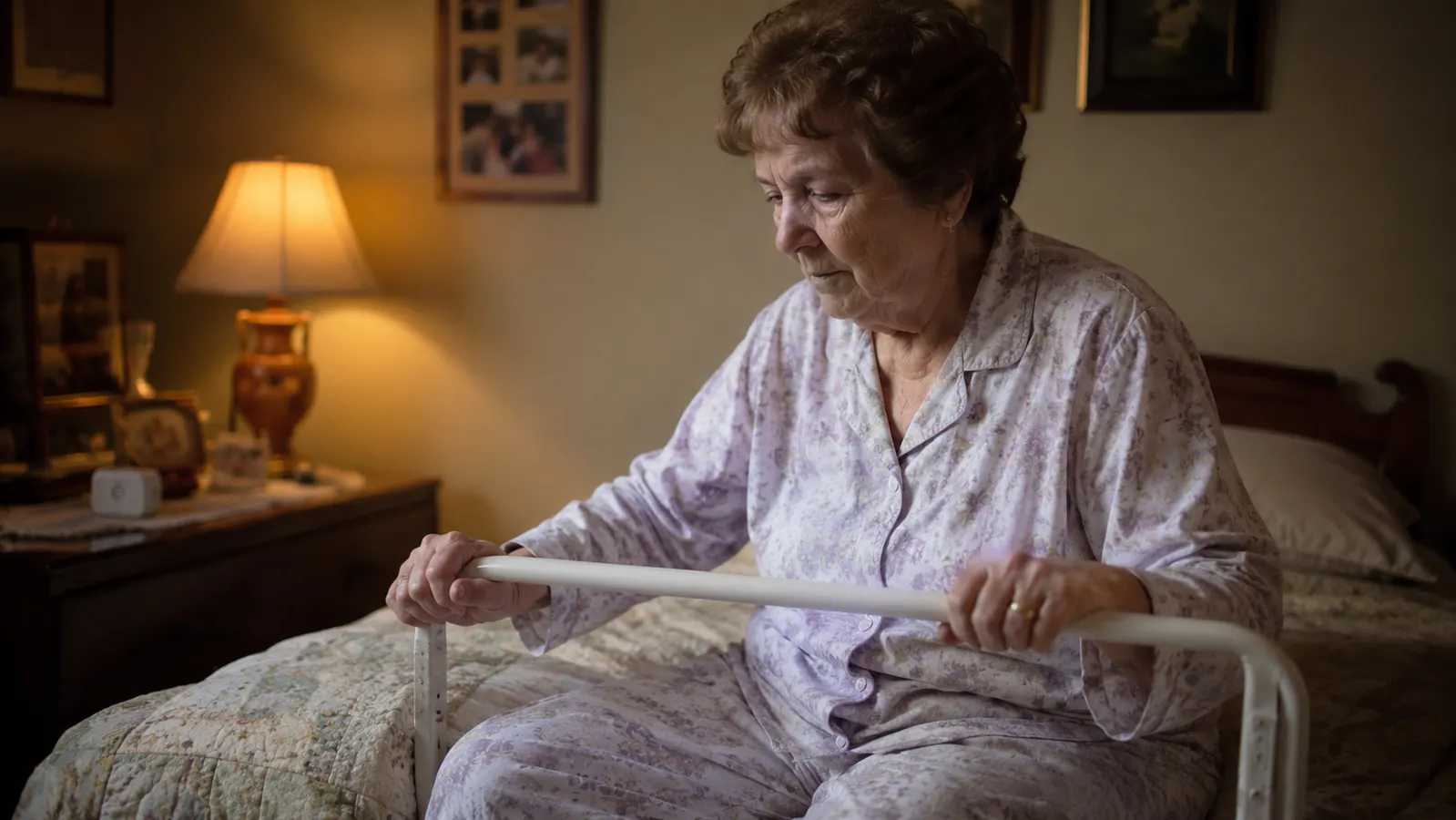
I asked Mom to describe using the bar in her own words, which I think is more useful than anything I observed from outside the room. She said: it feels like having something solid to hold on to that is always exactly where she expects it to be. Before the bar, she would reach for the nightstand or the wall, and neither was reliably the right height or in the right place when she was groggy at 2am. The bar is always at the same height, always in the same position, and the grip gives her enough friction that she does not feel like she might slip even when her hands are dry.
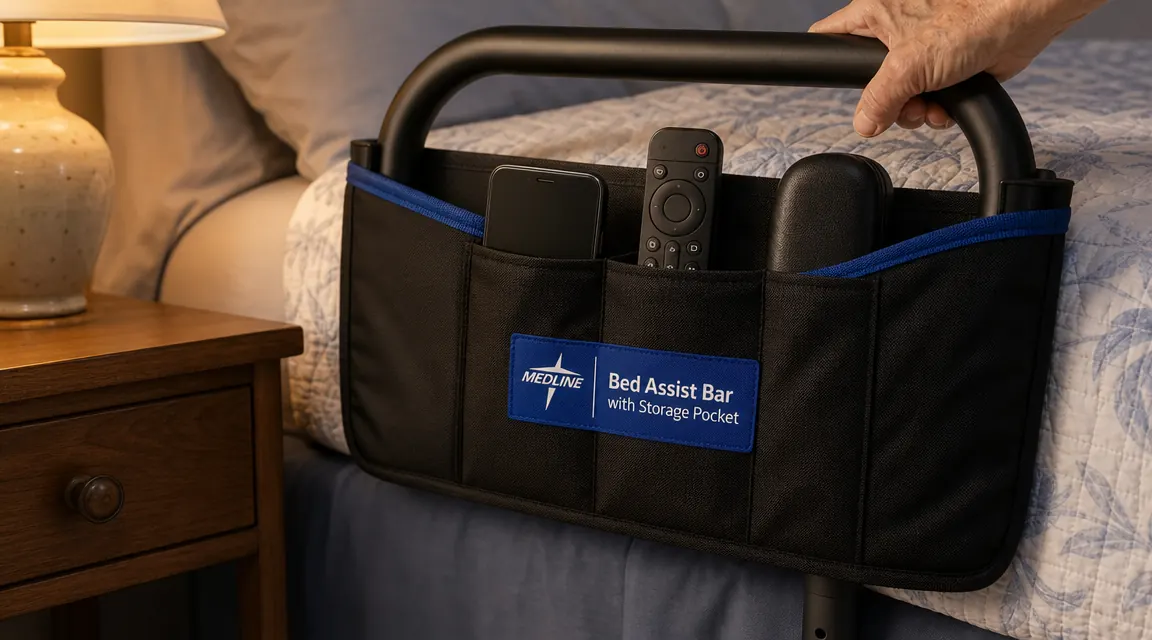
She also uses the storage pocket more than I expected. Her phone, her reading glasses, and her TV remote live in that pocket now. That is not a trivial thing. Reaching across the bed to the nightstand to find her phone in the dark was itself a fall risk she had been taking every night without either of us thinking about it. The pocket solved that without my having to say anything.
Her one complaint: the rail is white, and her bedroom is warm-toned walnut and burgundy, so it stands out visually. She mentioned it twice in the first month and has not mentioned it since. I will take that trade.
The Wobble Question: Honest Numbers
The most common negative review I see on this product is some version of 'it wobbles.' I want to give you a calibrated answer because the word wobble covers a lot of ground. For pure lateral force, meaning you push the top of the rail sideways toward or away from the bed, on a firm mattress you will feel very little movement, and on a soft mattress you will feel noticeable but not alarming movement. This is physics. The base plate compresses into the mattress, and a softer mattress compresses more under load, which allows more lateral play.
For vertical force, meaning you push the grip straight down, the bar is rigid on any supported mattress because that force drives the base plate further into the mattress. Getting-up motion is mostly vertical push, which is why the bar works well for its intended purpose even on soft mattresses. The wobble people experience is usually present only during installation testing, not during actual use. If you are doing a lateral wiggle test and getting nervous, try a vertical load test first. That is the force your parent is actually going to apply.
What I Liked
- Steel frame rated to 300 lbs is genuinely overbuilt for most users
- Adjustable handle height allows ergonomically correct positioning
- Storage pocket is a real quality-of-life upgrade, not just a gimmick
- Installation on a standard mattress and box spring takes under ten minutes
- Compatible with twin through king bed widths without modification
- Rated 4.6 stars across 15,000 reviews, which is a meaningful signal
Where It Falls Short
- Not designed for adjustable or split-king beds without additional verification
- Lateral wobble on very soft pillow-tops may be noticeable at installation, though it does not affect vertical-load performance
- White finish does not blend into warm-toned traditional bedroom decor
- One-month re-check is necessary on pillow-top mattresses as foam settles
Who This Is For
The Medline Bed Assist Bar is the right product for a senior who can get themselves to a seated position but struggles with the sit-to-stand transition, or who needs a confident handhold when lowering themselves from standing to lying. That describes the majority of the aging parents I hear about in caregiver conversations. It is also the right product for someone whose confidence has dropped after a fall or a near-miss, even if they technically have the strength to get up without help. The bar provides the psychological certainty that something solid is there. That matters more than most people realize.
At this price point, I would also suggest it as a preventive purchase, not only a reactive one. If your parent is getting up at night and you have a low-level worry about it, installing this bar before an incident is far easier than installing it after one. The conversation is also easier before an incident, when you can frame it as a convenience rather than a safety response.
Who Should Skip It
If the concern is nighttime rolling out of bed during sleep, especially in someone with dementia, restlessness, or significant motor impairment, this is not sufficient. Full-length bed enclosure rails or bolster positioning systems are the appropriate category. Likewise, if your parent cannot reliably bring themselves to a seated position at all, the next conversation is usually with a physical therapist about a hospital-style bed with full side rails, not a retail assist bar. The Medline bar is good at what it does and not designed for the two situations I just described. Buying it for those situations sets you up for disappointment. For more on the distinction between assist bars and full-length guards, see our breakdown at Bed Assist Bar vs Full-Length Bed Rail.
Eleven months in, I would buy it again without hesitating.
The Medline Bed Assist Bar costs less than one urgent care copay and installs before bedtime. If your parent is having trouble getting in or out of bed safely, this is the right place to start. Check the current price and availability on Amazon.
Amazon Check Today's Price on Amazon →