

I spent 20 years inside a family medicine practice watching patients come in with fall injuries they swore would never happen to them. Now I am the one at the nurse's station AND the one helping my 79-year-old mother get out of bed safely every morning. So when I tell you I have read every one-star review of the Medline Bed Assist Bar before recommending it, I mean that literally. I needed to know what I was sending her home with.
Here is what I found: most of the complaints are real, most of them are preventable, and almost none of them show up in the product description. This review is the thing I wish I had read before I ordered. It covers the mattress issue that will make or break the whole setup, the wobble that startles people at 2am, the storage pocket that sounds useful and mostly is not, and the specific situations where you should skip this product entirely and buy something different.
The Quick Verdict
Solid, affordable bed rail for standard mattresses on a box spring , but it has three real limitations that matter depending on your parent's setup and strength level, and the listing undersells all three.
Amazon Check Today's Price →If your parent's mattress is under 12 inches thick and sits on a box spring, this rail is very likely the right call.
At the current price it is one of the most cost-effective bed safety investments you can make. Check that your mattress qualifies first , I explain exactly how below.
Amazon Check Today's Price on Amazon →The Mattress Problem Nobody Puts in the Title
The Medline Bed Assist Bar works by sliding a flat metal base plate between the mattress and the box spring. The weight of the mattress holds the base in place, which in turn holds the rail upright. It is a clean, tool-free design and it actually works well. The problem is that it only works if the base plate can get far enough under the mattress to create real compression. And that requires two things most listings do not state clearly.
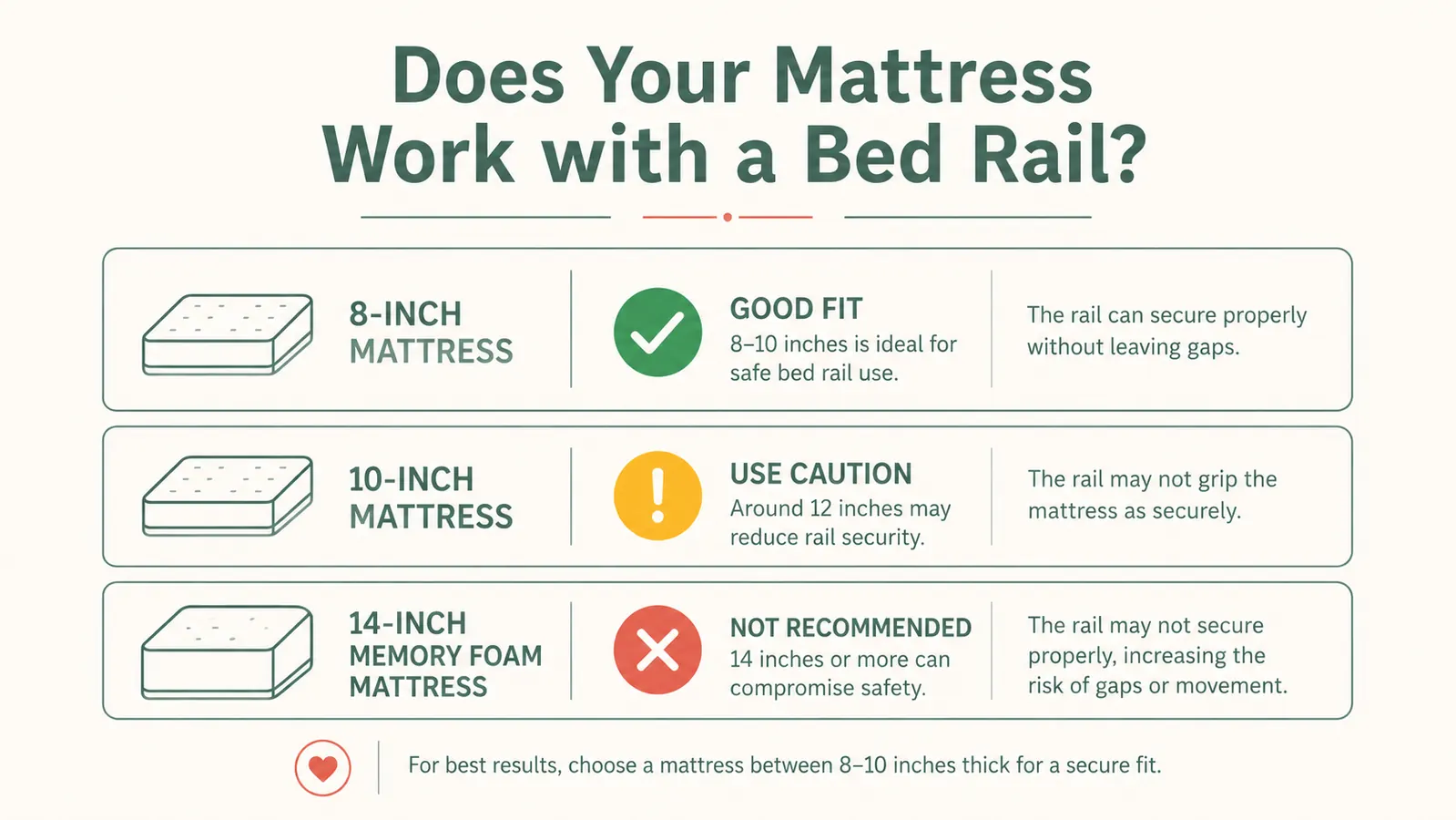
First, you need a box spring or a platform bed with a solid hard perimeter edge. If your parent's bed uses a slatted bed frame with nothing around the edge, the base plate has nothing to grip. It will flex toward the floor when weight is applied. I have seen this situation in three separate patient home visits and every time the family was surprised. Second, mattress thickness matters more than you think. On a 12-inch mattress the base plate fits correctly. On a 14-inch or thicker memory foam mattress, there often is not enough compression weight near the edge to hold the base secure. The mattress lifts slightly when someone grips the rail and the whole unit shifts. It does not tip over dramatically, but it moves. And movement at 2am when someone is half-asleep and grabbing for support is a problem.
Before you order, press your hand into the mattress edge near where the rail would sit. If it compresses significantly and bounces back, that foam is probably too soft and thick for a good base-plate grip. Standard innerspring and hybrid mattresses under 12 inches are almost always fine. Thick all-foam mattresses are hit or miss. That is the real first question.

The Wobble: What It Is and Why It Surprises People
Even on a correctly installed rail with an appropriate mattress, there will be some lateral movement. I want to be specific here because I see this described as a defect in the one-star reviews and I do not think that is accurate. It is a characteristic of the design, not a manufacturing flaw.
When someone uses this rail to push themselves upright from a lying position, they apply force mostly forward and upward. The rail handles that well. When someone grabs the rail and pulls sideways, or leans on it at an angle, there is noticeable flex. It does not collapse, but it will rotate a few degrees on the base plate. For a 145-pound woman with decent upper body strength who is using it primarily to push up, this is not a real concern. For a 220-pound person who is using the rail as their primary balance support to stand from a very low mattress while also having significant weakness on one side, that flex will feel unstable and could be genuinely unsafe.
This rail was designed to assist getting in and out of bed. It was not designed to fully substitute for upper-body strength. That distinction matters more than the product listing suggests.
My mother uses it the right way. She sits up first, then grips the rail to steady herself as she swings her legs over and stands. At 154 pounds and with reasonable arm strength, the minor flex does not register. Her neighbor, who weighs more and had a shoulder replacement last year, tried the same rail and found the lateral movement unsettling. Different person, different outcome, same product.
The Storage Pocket: Honest Assessment
The rail comes with a fabric storage pocket that attaches to the upright bar. It holds a phone, TV remote, glasses case, a book. The idea is that you keep the things your parent reaches for most often right there at arm's reach instead of having them get up in the middle of the night.
Here is the honest part: the pocket is fine. It is not great. The fabric is thin, the stitching is serviceable but not robust, and the pockets are awkwardly shaped for most items. My mother tried keeping her phone in it for two weeks. The main complaint was that the pocket sat right at the level where she would accidentally brush it when getting in and out of bed, and things fell out. She moved the phone back to the nightstand. The pocket is now used for her TV remote, which is fatter and stays put more easily.
The storage pocket is a genuine bonus if it works for your parent's specific items and habits. It is not a meaningful selling point to factor into the purchase decision. Buy this rail for the rail. Think of the pocket as a small extra.
Height Adjustment and Fit for Different Users
The rail is height adjustable within a reasonable range. You set it by loosening a collar, sliding the upper section, and re-tightening. The adjustment range covers most standard adult heights when used with a standard-height bed. The goal is to have the top of the rail at roughly hip height when the person is standing beside the bed, so they are pushing down and forward rather than reaching up or hunching.
One thing I noticed when setting up my mother's: the collar that locks the height can loosen over time with repeated use if it is not snugged down properly at installation. Check it at the two-week mark. This is not a safety recall issue, it is just normal metal-on-metal wear on an adjustment collar. Tighten it, it is fine. But if you do not catch it, the rail will slowly drop over several weeks and the person using it may not notice because the change is gradual.
The bar itself is padded at the grip section. The padding is firm, not plush, and holds up well. I have seen foam grips on cheaper rails deteriorate and peel within a year. The Medline padding has held its shape on my mother's rail through regular daily use without any visible degradation.
Installation: What the Instructions Do Not Show You
The included instructions are adequate for someone who is comfortable with light assembly and pays attention. For a caregiver who is setting this up alone in a hurry at the end of a stressful day, there is one step that catches almost everyone the first time.
The base plate needs to go under the mattress far enough that the weight distribution creates real resistance when the rail is loaded. The instructions say to slide the base under the mattress. They do not tell you how far. The answer is: as far as it will go without the mattress lifting at the edge. On my mother's queen-size bed this was about 14 inches from the edge. On a very heavy pillow-top mattress this might be less. The test is simple: grab the top of the rail and push toward the foot of the bed with moderate force. If the base shifts, slide it in further and test again. If it holds solid, you are done.
Whole setup, correctly done, is about 12 minutes. There are no tools required. The rail arrives mostly assembled.
What I Liked
- Tool-free installation in under 15 minutes for standard beds
- Height adjustable to fit most adults using standard-height beds
- Padded grip holds up over time without peeling or compressing flat
- Solid performance for users under 200 lbs on correctly installed setups
- Storage pocket is a genuine bonus for keeping commonly used items bedside
- Available at a price point that does not require insurance or a medical supplier
Where It Falls Short
- Does not work reliably on thick all-foam mattresses over 12 inches
- Requires a solid mattress foundation (box spring or solid platform) to secure properly
- Lateral wobble is noticeable and can feel unsafe for heavier or weaker users
- Height-lock collar needs checking at 2 weeks , it can loosen with regular use
- Storage pocket sizing is awkward for most common items
- Not a substitute for full upper-body strength support; misuse is easy and common

Who This Is For
This rail is a good fit for a parent who has the core strength and coordination to sit up independently but needs help with the transition from sitting to standing, or needs something to steady themselves as they swing their legs off the bed. It works best for someone who is somewhat mobile but not fully confident on the first few seconds of standing, especially at night when the vestibular system is slower to catch up. Weight under 200 pounds, standard mattress under 12 inches, solid bed frame. Those are the three conditions where I would recommend it without reservation.
It is also a strong choice for someone recovering from a procedure who needs temporary support getting in and out of bed but does not need a full trapeze bar or grab rail system. The price point makes it reasonable to use short-term without a big investment.
Who Should Skip It
If your parent cannot sit up independently from a lying position, this rail will not solve that problem and may actually create a false sense of security that leads to a fall. The rail is a transition assist, not a full transfer device.
If their mattress is a thick memory foam model, especially those 13 inches or taller that have become popular in the last five years, I would strongly recommend measuring before ordering. You may need a rail that clamps to the bed frame itself rather than relying on mattress compression. That design is more expensive and more involved to install, but it is actually secure on any mattress type.
If your parent has significant weakness on their dominant side, or a recent stroke affecting arm and grip strength, the lateral flex in this design is a real concern. I have seen caregivers in our office describe falls where the person pushed off a rail that shifted unexpectedly. The rail did not tip over. It just moved two inches at the wrong moment. For someone in that situation, a more rigid floor-to-frame mounted grab bar or a half-rail with a locking clamp mechanism would be a safer choice. You can read my comparison of this rail against full-length bed guards to see those options laid out side by side.
And if the nighttime fall risk involves your parent rolling out of bed rather than struggling to get up, this rail addresses the wrong problem entirely. A bed assist bar is not a restraint and should never be used as one. You need a different category of product. I cover that in detail in the comparison article linked below.
The Bottom Line on the Reviews
15,000 reviews on Amazon sounds like a lot of social proof. And it is, but only for the situations where this product fits. When I read through the one-star reviews carefully, a pattern appears: almost every negative experience falls into one of three categories. Wrong mattress type. Wrong use case (the person needed more support than this design provides). Or installation done too quickly without testing the base plate position. None of those are product defects. They are fit problems.
The four and five star reviewers are mostly describing a situation that matches those three conditions correctly: standard mattress, box spring, user who can sit up but needs help standing. For those people, the rail does exactly what it says and they are happy. That is genuinely useful information. The question is whether your parent's situation falls into the majority or the minority.
If you want to hear what happened the first night after installation in a real caregiving situation, my colleague's account of that experience is worth reading. She ordered it in a hurry the same night her mother slipped twice. Her account covers what she noticed in the first 12 hours that the instructions did not prepare her for.
Right mattress, right user, right install , this rail earns its 4.6-star average.
If your parent's bed qualifies (standard mattress under 12 inches, solid base) and they can sit up on their own, this is one of the most practical bedroom safety investments available at this price. Check the current price before you decide.
Amazon Check Today's Price on Amazon →