

The simple weekly pill case has been around for decades, and there is a reason. For a healthy 70-year-old who takes one blood pressure pill in the morning and remembers it the same way they remember to brush their teeth, a seven-compartment plastic box from the drugstore does exactly what it needs to do. I have recommended them hundreds of times over twenty-plus years working in a medical office.
But here is what I also know from that same experience, and from managing my own mother's care at home: the moment memory starts to slip, or the medication count climbs past three or four, or the dosing schedule splits across morning and evening, the simple pillbox stops being a solution and quietly becomes a liability. Your parent thinks they took their metformin. They are not sure. They take it again. Or they skip it entirely and say nothing because they are embarrassed. Neither of those outcomes is acceptable when the medications in question include blood thinners, heart medications, or diabetes drugs.
| Feature | Simple 7-Day Pillbox | Medcenter Monthly Organizer |
|---|---|---|
| Price | ~$5 to $15 | ~$89.79 |
| Compartments | 7 (once daily) | 124 (31 days x 4 times/day) |
| Alarm / Reminder | None | Talking alarm, up to 4 alarms/day |
| Monthly view for caregivers | No | Yes, full month visible at once |
| Works for memory concerns | Marginally | Yes, designed for it |
| Multiple daily doses | Requires multiple boxes | Built in (AM, Noon, PM, Bedtime) |
| Visual missed-dose check | Limited | Easy at a glance across 31 days |
| Setup complexity | None | Moderate, one-time clock programming |
| Portability | Very easy | Stays at home base |
Where the Medcenter Monthly Organizer Wins
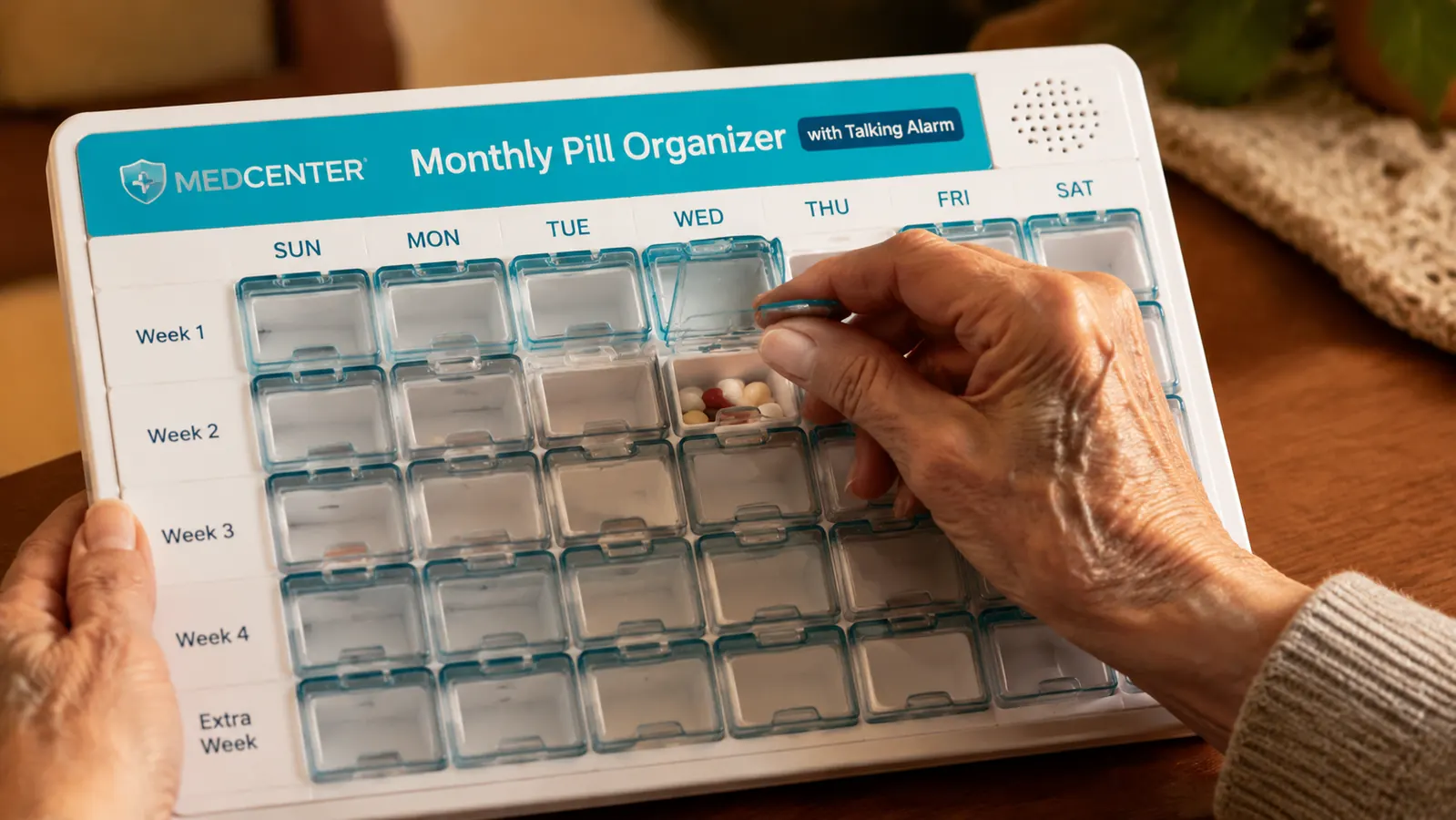
The clearest win for the Medcenter is the talking alarm. It announces the time to take medications in a clear, audible voice at whatever intervals you program, up to four times per day. For a parent with mild to moderate cognitive decline, or simply someone who gets absorbed in a television program and loses track of time, this changes everything. A silent pill organizer sitting on the counter is easy to ignore. A voice that says it is time for your medication is not.
The second win is the monthly view. I cannot overstate how useful this is for caregivers who are not in the house every day. When I fill my mother's organizer at the start of each month, I can see at a glance on any given visit whether she has been taking her doses consistently. A partially filled compartment from three days ago tells me something worth knowing before her doctor appointment. With a seven-day box, you only see this week, and only if you remember to check before you refill it. The full thirty-one-day grid is a passive monitoring system that asks nothing extra of you.
The four-times-per-day structure is also a genuine differentiator. Seniors on complex regimens often have medications that must be taken at different times, including some that cannot be taken together. A standard weekly box has one compartment per day. The Medcenter has four labeled compartments per day, for a full month. That is 124 individual compartments, color-coded and clearly marked. For a parent on five or more medications with split schedules, this is the only non-pharmacy solution that keeps it all organized in a single place.
Where the Simple Pillbox Wins
Cost is the obvious one. A quality seven-day pill organizer with easy-open lids runs somewhere between five and fifteen dollars. If your parent has no memory concerns, takes a small number of medications all at the same time each day, and has already built the habit into their routine, spending ninety dollars on a talking alarm organizer is not the right call. It would be like buying a GPS for someone who has driven the same route to work for thirty years.
Portability is also a legitimate advantage. The Medcenter is a base-station organizer. It is not designed to travel. If your parent is active, spends time at a second home, or travels frequently, a simple weekly box that fits in a toiletry bag will serve day-to-day travel better. Some families keep the Medcenter at home for the primary schedule and use a small weekly box for trips.
Your parent's medications are too important to rely on memory alone.
The Medcenter Monthly Organizer with Talking Alarm has 2,060 reviews and a 4.5-star rating from caregivers managing exactly this situation. Check the current price on Amazon.
Amazon Check Today's Price on Amazon →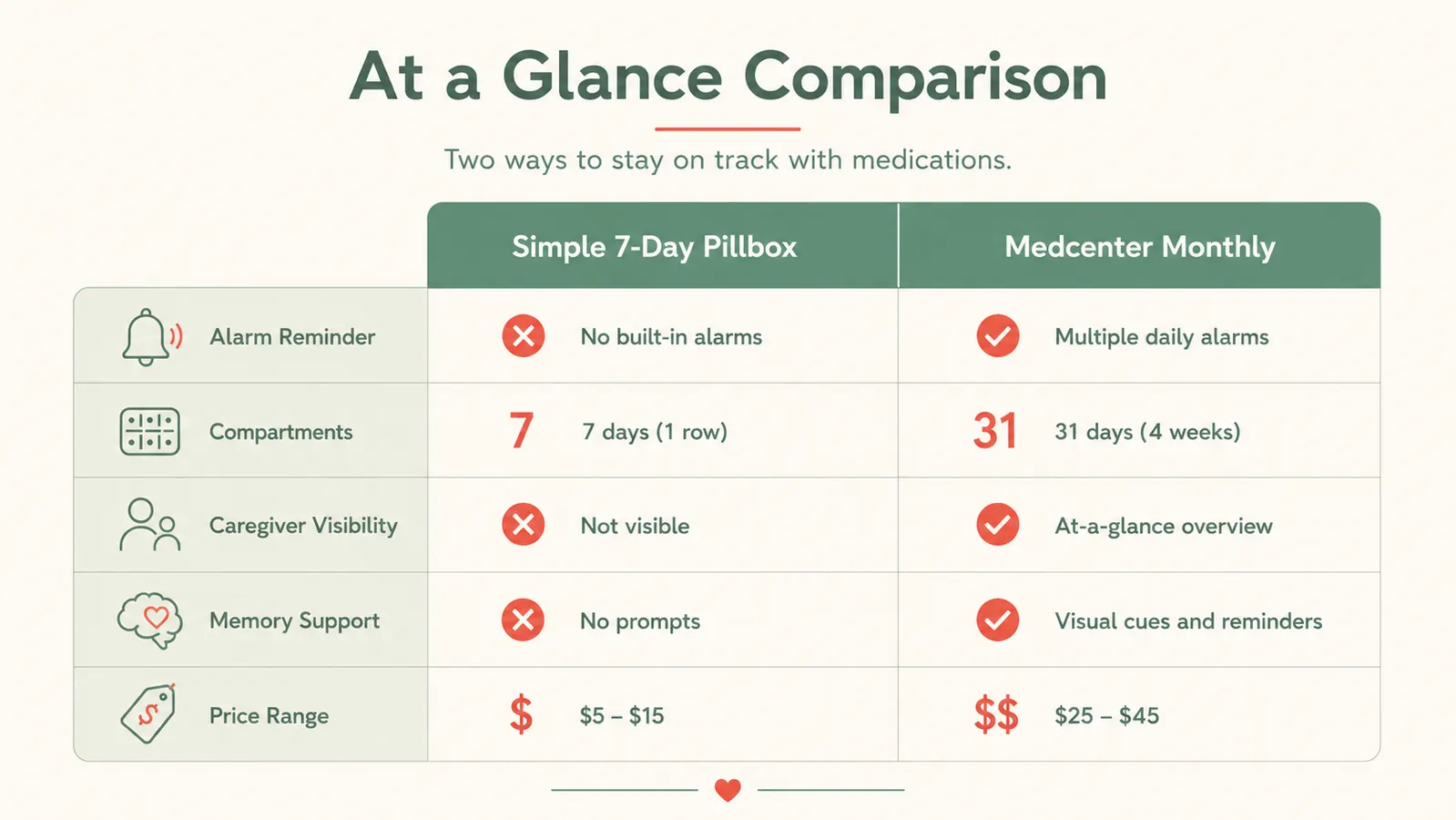
The Missed Dose Problem Is Bigger Than It Looks
In the medical office, we see medication non-compliance show up as worsening lab results before the patient even knows something is wrong. A missed dose here and there feels harmless from the patient's perspective. From the chart, it looks like the medication is failing. The doctor adjusts the dose upward. Now the patient is on more medication than they actually need, which brings its own side effects. This cycle happens quietly and constantly.
For a parent on blood thinners, even one or two missed doses can shift their INR enough to matter. For someone on diabetes medications, skipping a dose can mean blood sugar spikes that cause fatigue, confusion, and long-term vascular damage. I am not saying this to frighten you. I am saying it because most families do not connect the dots between a casual missed pill and the downstream clinical consequences. A talking alarm that announces medication time is not paranoid. It is the same thing a nurse does on a hospital floor, just at home.
A silent pill organizer is easy to ignore. A voice that announces it is time for your medication is not. That distinction matters more than it sounds.
Setting Up the Medcenter: What the Instructions Skip
The setup is the most common friction point for this organizer, and it is worth addressing directly. Programming the clock and alarm schedule takes about fifteen minutes the first time, and the instruction booklet is not particularly intuitive. The approach that works is to sit down with the instructions, ignore the diagrams, and just follow the numbered steps in sequence. Once the initial setup is done, you typically do not touch it again. The alarm runs on its own schedule indefinitely.
Filling the organizer for the full month takes about twenty to thirty minutes at the start of each month. Some caregivers do it together with their parent, which has the added benefit of the parent seeing exactly what they are taking and why. Others fill it privately and deliver it. Either way, once it is filled, the system runs itself. The alarm sounds, the parent opens the correct compartment for that time of day, and the dose is taken. You will know if something was missed on your next visit without having to ask.

Who Should Buy the Medcenter
Get the Medcenter if your parent takes four or more medications, if any of those are dosed more than once per day, or if there is any concern at all about memory or routine. You should also get it if you are a long-distance caregiver who needs passive reassurance that medications are being taken consistently. The monthly grid gives you that without daily phone calls. And you should get it if your parent has already missed doses with a simpler system. One missed blood thinner is one too many.
Who Should Stick with a Simple Pillbox
Stay with the basic weekly box if your parent is cognitively sharp, takes only one or two medications at the same time each day, and has a reliable existing habit. Same for parents who travel frequently and need something portable. There is no reason to solve a problem that does not exist. The simple pillbox is not inferior. It is just the right tool for a different situation, and for many seniors it remains exactly right. The honest answer is that you know your parent's reliability with medications better than any review can tell you. If you have never had a scare, a basic organizer is probably fine. If you have, read on.
For further reading on building a full medication management system around your parent's specific needs, including when to involve the pharmacist and when to ask the doctor about blister packaging, see our guide on how to stop an elderly parent from missing medications. And if you want the deep-dive on long-term use before committing to the Medcenter, the nine-month review of the Medcenter with eight daily medications covers real compliance data from extended use.
If missed doses are already a concern, this is the system that fixes it.
The Medcenter Monthly Pill Organizer with Talking Alarm handles up to four doses per day across a full 31-day month. Over 2,000 caregivers rely on it. See the current price and what buyers are saying on Amazon.
Amazon Check Today's Price on Amazon →