

I have sat across from patients in our medical office and watched their faces go blank when the doctor asks, "Are you taking your medications as prescribed?" They think they are. Their family thinks they are. And then we pull the pill count and discover that a week of blood pressure medication is still sitting in the bottle from two months ago. Medication non-adherence is not laziness. It is a logistics problem, and logistics problems have solutions.
My mother takes seven daily medications. She is 79, sharp as a tack mentally, and still missed doses twice in one month last fall because the routine got disrupted by a dental appointment and a grandchild's birthday party. If it can happen to her, it can happen to your parent. This guide is the system I built for my own family, drawing on 20-plus years of watching what works clinically and what actually holds up in a real household.
If you just want the best tool to anchor the whole system, start here.
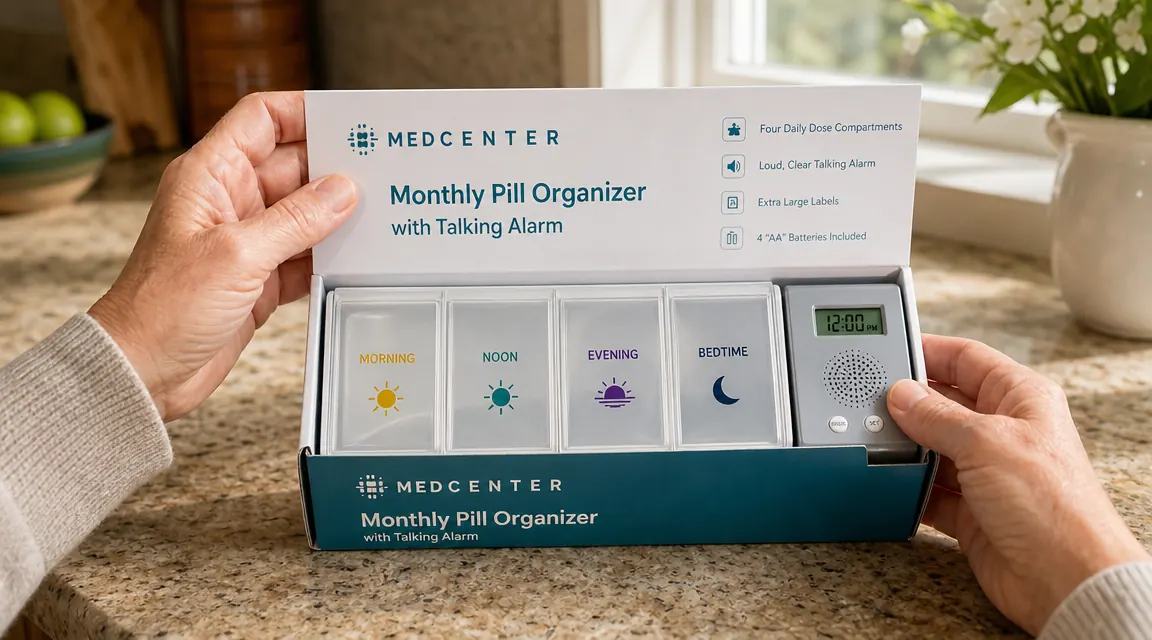
The Medcenter Monthly Pill Organizer with Talking Alarm is what I use for my mother. It covers 31 days, four doses per day, and the talking alarm reminds her by name what time it is and that her medications are waiting. More on why this matters in Step 4 below.
Amazon Check Today's Price on Amazon →Step 1: Build the Master Medication List
Before you can fix a broken medication routine, you need a single, accurate document that lists every medication your parent takes, including the dose, frequency, prescribing doctor, and what the medication is for. This sounds obvious. Almost no family has one.
Go to every pharmacy your parent uses, not just the primary one, and ask for a printed medication history. Older adults often use a chain pharmacy for maintenance medications and a different pharmacy or mail-order service for specialty drugs. Collect them all. Then cross-reference with the bottles in the medicine cabinet. You will almost certainly find discrepancies: a medication that was discontinued but whose bottle is still there, a dose that was changed three months ago but whose old bottle was never thrown out, or a supplement nobody thought to mention.
Write the final list clearly, in large print, and post one copy inside a kitchen cabinet they open every day. Keep a second copy in your own records. Take a photo of it for your phone. This document is the foundation of everything that follows. Every time a prescription changes, update every copy immediately.
Step 2: Consolidate to One Pharmacy
If your parent is filling prescriptions at two or three different pharmacies, get everything moved to one. This is one of the most practical things you can do, and it is almost always possible. Call each pharmacy and ask them to transfer the prescriptions. Most pharmacists are glad to help and will do the coordination themselves.
A single pharmacy gives you two major advantages. First, the pharmacist's computer can flag dangerous drug interactions that no individual prescriber's office has visibility into, because that office only sees the medications they prescribed. Second, you gain a single point of contact for refills, questions, and adherence packaging. Many pharmacies now offer blister packs or unit-dose packaging at no extra charge, where each daily dose is sealed in its own bubble and labeled with the date and time. For parents who are confused about whether they took a dose, a blister pack makes it obvious: the bubble is either intact or it is not.
Ask specifically about automatic refill enrollment. Most chain pharmacies will auto-refill maintenance medications and either hold them for pickup or mail them. Running out of a critical medication, a blood thinner, a heart medication, a diabetes drug, is one of the most preventable emergencies caregivers face.

Step 3: Simplify the Schedule With the Prescribing Doctors
Many older adults take medications at three or four different times per day simply because that is how they were originally prescribed, not because the clinical schedule still needs to be that complex. A conversation with the prescribing physicians can often consolidate multiple doses into a single daily dose or a twice-daily schedule without any loss of effectiveness.
Do not be shy about raising this at the next appointment. You can simply say: "Mom is having trouble remembering the 2pm dose. Is there a once-daily version of this, or can we adjust the timing?" In my experience in clinical practice, most physicians welcome this question. They would far rather prescribe a once-daily formulation that a patient actually takes than a theoretically optimal twice-daily version that gets skipped half the time. Medication that stays in the bottle does nothing.
If your parent sees multiple specialists, consider requesting a comprehensive medication review with the primary care physician. This visit, sometimes called a brown bag review because you bring in every bottle your parent has, exists specifically to look for redundant medications, outdated prescriptions, and opportunities to simplify. Some primary care offices will do this by phone or secure message. It is worth asking.

Step 4: Install a Structured Organizer with an Alarm
Once the schedule is simplified as much as possible, you need a physical system that makes the right action easy and the wrong action (taking a double dose, skipping a dose) hard. A simple plastic weekly pillbox costs three dollars and works fine for some people. For anyone taking four or more medications, managing multiple daily dose times, or dealing with any early memory changes, it is not enough.
The organizer I settled on for my mother, after trying two others, is the Medcenter Monthly Pill Organizer System with Talking Alarm Clock Reminder. It holds a full 31-day supply across four daily time slots (morning, noon, evening, bedtime). Each day is a removable tray, which matters: I fill all 31 trays at the start of each month, and she simply pulls that day's tray from the rack. The talking alarm feature is the real differentiator. At the scheduled alarm time, a recorded voice says the time and prompts her to take her medications. For a parent whose memory is intact but whose sense of time drifts, that verbal cue does something a silent phone buzz cannot.
The setup does take an hour the first time. You program each alarm for the daily dose times, and then fill 31 days of trays at once. I do this on a Sunday afternoon at my mother's kitchen table. It has become something of a ritual: we talk while I sort the pills, she makes coffee, and we review what each medication is for. That repetition has made her more engaged with her own care, not less. She knows her blood pressure pill by sight now. She knows why she takes it.
The talking alarm does something a silent phone buzz cannot. It says her name, says the time, and says her medications are waiting. For a parent whose memory is intact but whose attention drifts, that specificity is the difference between a dose taken and a dose missed.
At a 4.5-star rating from over 2,000 verified buyers, the Medcenter organizer is not universally loved, and I want to be honest about why. The programming interface is a small LCD screen with small buttons, and it takes patience to learn. If your parent has significant vision impairment or arthritis severe enough to make small button-presses painful, this is worth knowing before you buy. In those cases, the blister-pack pharmacy option from Step 2 combined with a simple phone alarm may work better. But for most families managing a parent with four or more daily medications and no cognitive impairment, this is the most complete off-the-shelf solution I have found.

Step 5: Build in a Backup Verification System
Even the best organizer and alarm system can fail. Your parent might silence the alarm and get distracted. They might skip a dose when they feel nauseous and forget to take it later. The best medication systems have a secondary verification layer that catches these gaps without requiring constant hovering.
The lowest-friction backup is a brief daily check-in call timed to the most critical dose. If your parent takes a blood thinner or a cardiac medication in the morning, a ten-minute call around mid-morning, ostensibly just to say hello, gives you an easy opening: "Did you have breakfast? Good. Did your organizer alarm go off?" Most parents do not resist this as caregiving; they experience it as family contact. That framing matters.
A slightly more formal backup is a shared medication log. A simple notebook on the kitchen counter where your parent checks off each dose, or a whiteboard with the day's doses listed and space to mark them off, gives you visible evidence on your next visit and gives your parent a satisfying, low-tech completion ritual. Some families use a shared smartphone note or a free app like Medisafe, which sends a caregiver notification if a dose is not logged. Use whatever your parent will actually engage with. The most sophisticated system abandoned after a week is worth less than a spiral notebook used every day.
For long-distance caregivers, smart pill dispensers (separate from the Medcenter organizer, which does not have this feature) can send you a phone alert when the lid is opened or not opened at the scheduled time. These run higher in price but are worth exploring if you are managing care from another city.
What Else Helps
Linking medication routines to an existing daily anchor, a meal, a morning television show, a specific time they always make coffee, dramatically improves compliance. This is called habit stacking in behavioral research, and it works just as well in an 80-year-old as in a 30-year-old. If your parent always eats breakfast at 8am, their morning medications should be sitting on the breakfast table, not in a bathroom cabinet. Environmental design is not a small thing.
Medication side effects are also worth reviewing explicitly. Many missed doses happen not because a parent forgot, but because a medication makes them feel unwell and they quietly decide to skip it without telling anyone. If your parent is regularly skipping a specific dose but taking others reliably, that pattern is information. Raise it with their physician before assuming it is a compliance problem.
When to Escalate to a Care Manager
If you have implemented this full system and your parent is still missing doses regularly, that is a signal to involve a professional. A geriatric care manager (also called an aging life care professional) can conduct a full medication review in the home, identify environmental or cognitive factors you may have missed, and coordinate with the medical team on your behalf. This is not giving up. It is using the right tool for a more complex problem. Your parent's primary care physician may be able to refer you, or you can search the Aging Life Care Association directory at aginglifecare.org.
Similarly, if your parent's missed doses are accompanied by any confusion about what their medications are for, concern about whether they already took a dose (beyond the normal human forgetfulness we all have), or any other cognitive changes, talk to their physician about a formal cognitive screening. Medication mismanagement is sometimes the first visible symptom of early dementia, and catching it early matters.
Ready to build the system? Start with the organizer that holds the whole routine together.
The Medcenter Monthly Pill Organizer with Talking Alarm covers 31 days and four daily doses, with a programmed alarm that speaks at each dose time. It is the anchor piece for the system described in Step 4, and for most families managing four or more daily medications, it is the single best-value investment in medication safety you can make.
Amazon Check Today's Price on Amazon →