

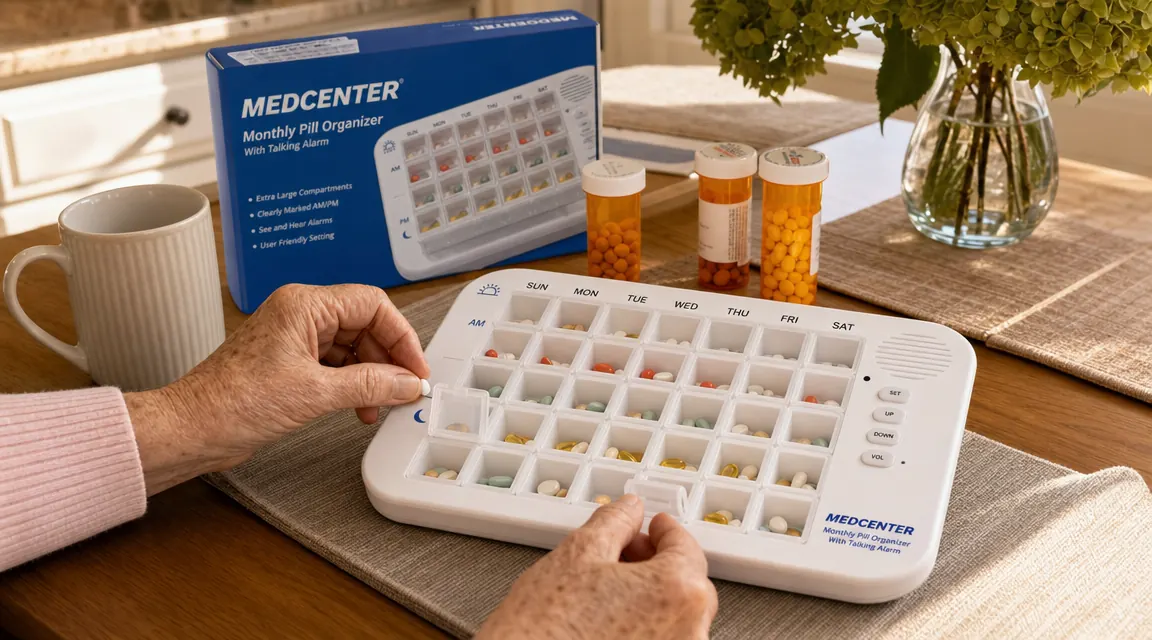
My mother, Eleanor, is 79 years old and takes nine medications every day. Two in the morning, three at noon, two in the evening, and two at bedtime. She has atrial fibrillation, hypertension, type 2 diabetes, and mild osteoporosis. Every single one of those pills matters. Missing her blood thinner even once is not a small thing. Missing her metformin two days in a row sends her glucose sideways and lands us in a phone call with her endocrinologist. For years, she managed with a basic weekly pill case I picked up at the pharmacy. It sort of worked. Then, in August of last year, I found three missed evening doses in the same week. That was the week I ordered the Medcenter Monthly Pill Organizer with Talking Alarm Clock Reminder.
I have been a medical office manager for 22 years. I have seen what non-compliance does. I know the ER visit trajectory. So when I found those three missed doses, I moved fast. Nine months later, I want to give you the honest report: what this system actually does well, where it falls short, and whether the current price is worth it for a family managing a complex medication schedule.
The Quick Verdict
The best talking alarm pill organizer on the market for multi-medication seniors, with a setup curve worth pushing through and a volume limitation worth knowing about before you buy.
Amazon Check Today's Price →Your parent's medication routine deserves better than a guessing game
The Medcenter Monthly Pill Organizer covers 31 days, four time slots per day, and announces each dose time in a clear spoken voice. It is the closest thing to a live reminder that does not require anyone to be in the room.
Amazon Check Today's Price on Amazon →How I Have Used It: 9 Months With a 9-Medication Routine
The Medcenter is a monthly organizer. That means 31 daily trays, each with four compartments labeled Morning, Noon, Evening, and Bedtime. You pull out each tray, fill it, snap it back in, and the alarm clock base handles reminders. The whole system sits on a surface like a small appliance, roughly the size of a hardcover book laid flat. Mom keeps hers on her kitchen counter next to the toaster, which turns out to be the right location because she is already standing there in the morning.
Every Sunday morning, we sit down together for what we now call the loading ritual. I pull the remaining trays, refill them in order, and check each one against her printed medication list. It takes about 20 minutes for nine medications across four slots. I keep a laminated card taped inside the cabinet above the organizer showing exactly which pill goes where. That card was my idea, and it was the single best change I made to the system. Without it, I was second-guessing myself on week three.
The alarm clock base has buttons on top that you use to set the four daily alarm times. Once set, those times stay programmed until you change them. The clock announces each dose time in a recorded voice, repeating the alert if the tray has not been removed. Mom knows the voice. She calls it 'the lady.' On mornings when I call to check in, she often mentions 'the lady already told me' before I even ask. That is the system working.
What the Talking Alarm Voice Actually Sounds Like
This is the question nobody answers in other reviews, so let me be specific. The voice is a pre-recorded female voice, clear American English, measured cadence. She says something along the lines of: 'Time to take your morning medication. Please remove the morning tray.' It is not robotic, but it is not warm either. Think automated phone system, mid-tier quality. The volume is adjustable, which matters enormously if your parent is hard of hearing. At maximum volume, it is loud enough to hear from the next room with a door open. It would not carry through a wall or to a second floor.
For Mom, who wears hearing aids and has them in by 7:30am, the volume on the second-to-highest setting is plenty. For someone with significant hearing loss who does not consistently wear aids, this organizer alone would not be sufficient. You would need a secondary visual alert or a caregiver check-in layered on top. I say that not to talk you out of it, but to set accurate expectations. The alarm does its job for someone who can hear a television clearly at normal volume.
Medication Compliance: The Before-and-After That Actually Matters
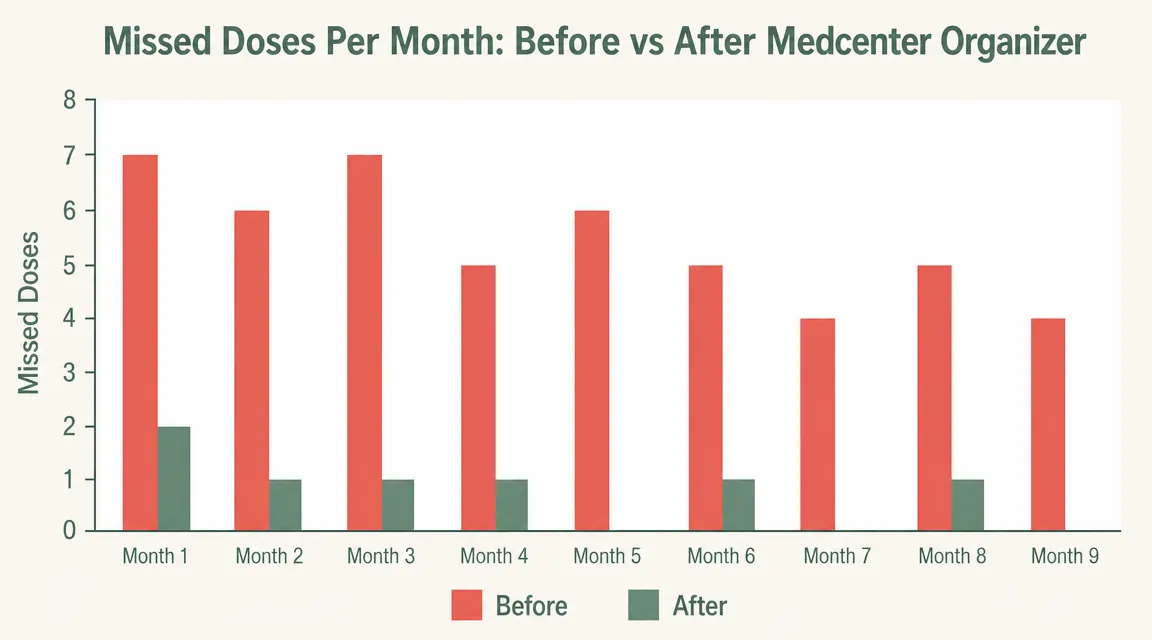
Before the Medcenter, Mom missed an average of four to five doses per month across all time slots. Most were evening doses, which makes sense. She is tired by 6pm and the routine is less anchored than her morning coffee ritual. In the first month with the Medcenter, we dropped to one missed dose. In month two, zero. We have had two missed doses total in the last six months combined, and both happened during a week when Mom was sick and sleeping unusually long hours, throwing off her normal schedule.
That is the real number: from roughly 54 missed doses in the year prior down to somewhere around 8 in nine months with this system. As someone who manages patient records for a living, I understand what that compliance shift means medically. Her A1C at her last appointment was the best it has been in three years. Her cardiologist noted her INR has been stable. I am not claiming the Medcenter did that alone. But a medication that actually gets taken is a medication that can work.
From roughly 54 missed doses in the year prior to about 8 in nine months. Her A1C at her last appointment was the best it has been in three years.
The Design Flaw Nobody Warns You About
The individual daily trays are small. That is by design: 31 trays have to fit in a compact housing. But the compartments within each tray are genuinely tiny, and some of Mom's medications are large oval tablets. Her fish oil softgel does not fit in any compartment without being the only thing in it. Her calcium carbonate tablet is borderline. We ended up leaving the fish oil and calcium out of the Medcenter entirely and handling those separately in a small standalone dish she keeps beside the organizer.
If your parent takes large-format supplements alongside their prescription medications, measure your largest pill before ordering. The compartments are approximately 1.5 inches by 1 inch by 0.5 inches deep. A standard prescription tablet fits fine. A fish oil softgel or a large vitamin D3 capsule may not, depending on brand. This is not a dealbreaker, but it is the adjustment I wish someone had told me about before week one.
The other thing worth knowing: the clock base runs on AC power with a battery backup. The battery backup is for timekeeping only during a power outage. It does not continue sounding alarms if the unit loses power. In our case that has never been an issue, but if you live somewhere with frequent outages or if your parent's bedroom is far from an outlet, plan accordingly.
The Setup Process: Where People Give Up and How to Not
Setting the four daily alarm times takes about 15 minutes and involves holding buttons in sequence while the clock cycles through each alarm slot. The instructions are not terrible, but they are written for someone who is comfortable with digital appliance menus. My mother could not have set this up herself. I set it up for her, confirmed all four alarms were active, and then wrote the four alarm times on a small card she keeps in her organizer drawer in case she ever needs to call me to reset one.
One thing that tripped me up: you have to set the current time before setting the alarms, and if you make a mistake during alarm setup it is easy to accidentally wipe a previously set alarm. Go slowly, verify each alarm before moving to the next, and use a watch or your phone to cross-check the displayed time before confirming. Once set correctly, I have not had to touch the settings in nine months except for the daylight saving time change, which requires resetting the clock time and then resetting all four alarms again. That took me 20 minutes the first time. Write down the alarm times.
How It Compares to What We Tried Before
Before the Medcenter, we used a standard seven-day pill case from the pharmacy. It had four rows labeled M, N, E, and HS and held one week at a time. The problem was not the container itself. The problem was there was no alarm, so taking pills depended entirely on Mom remembering, and the visual cue of seeing a full compartment was often not enough by itself. We also tried a basic digital pill dispenser with a single alarm. It beeped, Mom silenced it, and then forgot to actually take the medication. The Medcenter's spoken voice is meaningfully harder to dismiss than a beep.
If you want a detailed side-by-side breakdown of the Medcenter against a basic pillbox and when each one is appropriate, I covered that in my comparison piece on talking pill organizers versus simple weekly pillboxes. Short version: if your parent takes medications at more than two time slots per day, or if they have missed more than one dose in the past two weeks, the basic pillbox has already failed them.
What I Liked
- Covers a full month with four daily time slots, which eliminates the weekly refilling that most caregivers find unsustainable
- Talking alarm voice is clear, specific, and meaningfully harder to ignore than a beep
- Alarm repeats if the tray is not removed, which catches Mom on slow mornings
- Tray-pull mechanism is intuitive enough that Mom learned it the first day without coaching
- Battery backup keeps timekeeping accurate during brief power outages
- At 9 months of daily use, zero mechanical failures or compartment breaks
Where It Falls Short
- Compartment size cannot accommodate large softgels or oversized supplement tablets
- Volume at maximum is sufficient for mild hearing loss but not for significant loss without hearing aids in
- Daylight saving time changes require resetting all four alarms, which is fiddly
- Setup process assumes comfort with digital appliance menus and is not self-explanatory for everyone
- The alarm does not sound during a power outage, only the backup timekeeping function
Who This Is For
The Medcenter is the right choice if your parent takes medications at three or four different times per day, if they have missed doses in the past month, and if they can hear a conversational voice clearly when wearing their hearing aids. It is also right for caregivers who do not live with the person they are caring for, because loading it once a week and trusting the alarm system to handle the daily reminders is a genuine handoff. I do not call Mom every morning to remind her about her medications anymore. The Medcenter does that. That is time back in my day and dignity back in hers.
It is also right if you want a system that creates a trackable record. Because the trays are physical objects that get removed, I can glance at the organizer when I visit and know immediately whether today's doses have been taken. There is no app, no digital log, but there does not need to be. The empty tray tells the story.
Who Should Skip It
Skip the Medcenter if your parent has significant cognitive impairment and might not understand the connection between the alarm and the action. For memory-care situations, an automated pill dispenser that locks the other compartments and physically dispenses one dose at a time is a better fit. The Medcenter trusts the user to open the right tray at the right time. That trust requires a level of comprehension that not every senior has.
Also skip it if all of your parent's medications are large-format supplements or if they take only one medication once a day. The simpler solution wins when the complexity is not needed. My piece on when a talking pill organizer actually protects seniors walks through the specific risk indicators that justify the step up from a basic case.

Nine months in, I would buy this again without hesitation
The Medcenter Monthly Pill Organizer with Talking Alarm is the system I recommend to families managing complex medication schedules. It is not perfect and the setup takes patience, but no other organizer in this category has held up as well or produced the compliance results we have seen. Check today's price on Amazon and read the current reviews before you order.
Amazon Check Today's Price on Amazon →