

I want to tell you something about the Medcenter talking pill organizer that I could not find in any review before I recommended it to my own mother's care team: the alarm is not as loud as you are imagining it. That sounds like a small thing. For a senior with mild hearing loss living alone in a two-bedroom house, it is not a small thing at all. I am a medical office manager. I have spent 22 years watching patients get discharged with medication schedules that nobody in the world can reliably follow from memory. I know what happens when doses get missed, doubled, or taken at the wrong time. So when my mother, Dorothy, 79 years old, went from two daily medications to six after her cardiac event in early 2024, I started researching pill organizers the same way I research anything clinical: looking for what the marketing does not say.
The Medcenter System 4 Times a Day Monthly Pill Organizer (ASIN B000RZPL0M) is a legitimate, well-engineered product with a 4.5-star average across more than 2,000 reviews. It earns that rating. It also has three specific failure modes that almost nobody mentions, and at least one of them will matter to your family. This review covers all of them, because you deserve the full picture before you spend $89 on something your parent may or may not actually use.
The Quick Verdict
A genuinely useful medication compliance tool for seniors who are cognitively intact, have mild-to-moderate hearing loss, and take more than three medications daily. The setup is harder than advertised and the alarm volume has a real ceiling. Worth it for the right situation, wrong product for others.
Amazon Check Today's Price →Your parent is missing doses right now. This organizer is built for exactly that problem.
The Medcenter 31-day organizer holds four daily doses across a full month. It alarms, it talks, and it does not require your parent to remember anything except to respond when it goes off. For the right candidate, it is one of the most effective single purchases a caregiver can make.
Amazon Check Today's Price on Amazon →How I Have Actually Used This Product
My mother has six daily medications spread across three time slots: morning, noon, and evening. Her cardiologist added a fourth time slot briefly during an adjustment period, which is exactly what this organizer is built for. I set up the Medcenter for her in March 2024 and have been managing refills and alarm adjustments since then. I did not send this to her with the box instructions and hope for the best. I sat with her for about 90 minutes the first Sunday, programmed the alarm clock, filled all 31 days of trays, and walked her through the routine. That initial session matters a lot. I will explain why in the setup section.
I also have clinical context from the office side. Our practice manages several elderly patients on polypharmacy regimens of six or more medications, and we track which compliance aids patients actually use versus which ones end up in a drawer. Talking alarm organizers outperform silent ones by a wide margin in that population, which is a large part of why I chose this product for my mother over a simpler weekly box.
What I did not find in any review I read before buying: the programming interface is a physical clock with buttons, not digital, not app-connected, and the instruction manual uses language that assumes you already know how to set a talking clock. The first time I tried to set the alarm, I reset the entire clock to factory defaults by accident. That story is relevant. Let me walk through it.
The Setup Reality: What the Instructions Skip
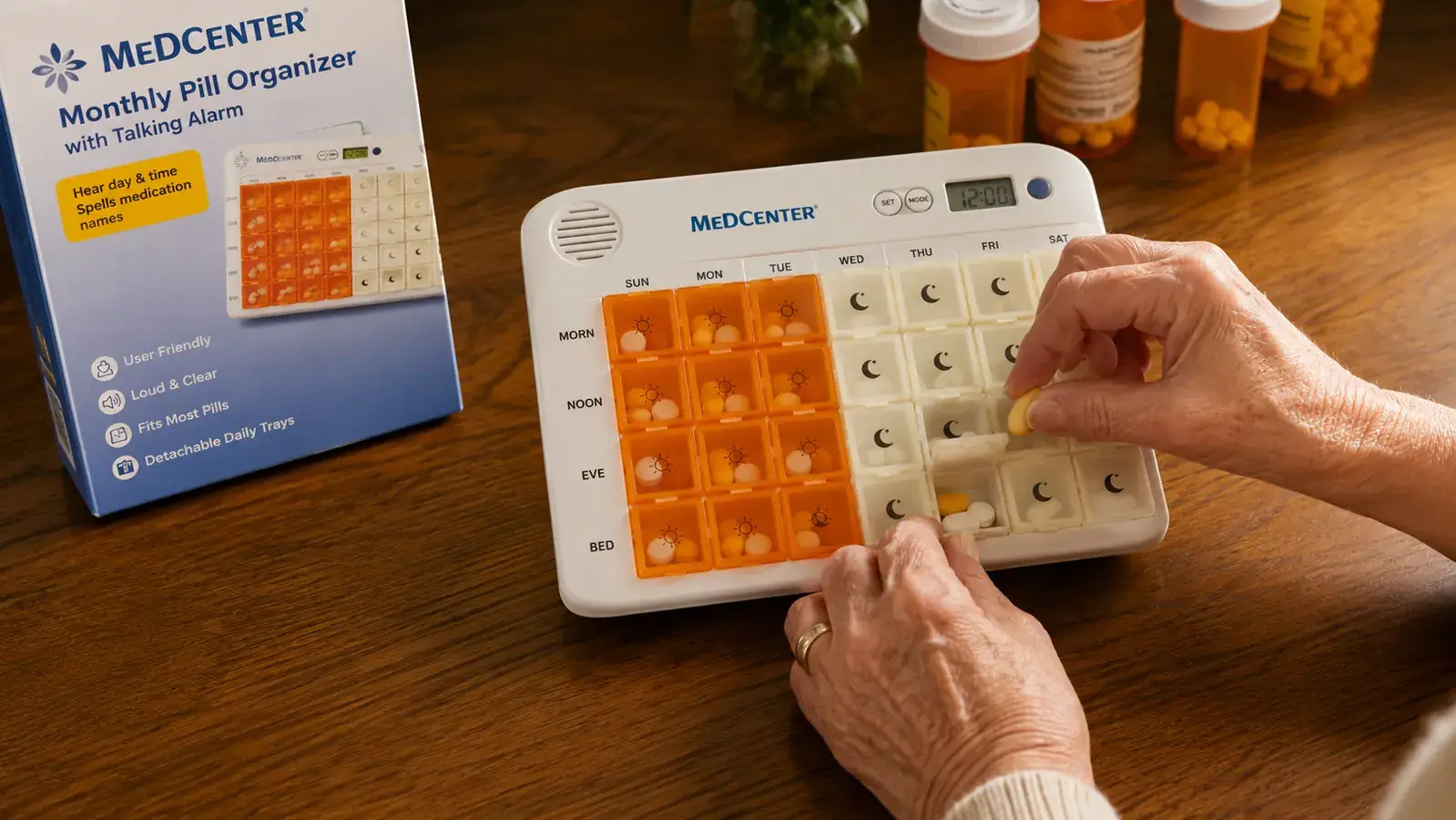
The Medcenter comes with a talking alarm clock module that sits on top of the organizer base, which holds 31 days of four-slot pill trays. The clock has four alarm settings, one for each daily dose time. Programming these alarms involves holding buttons in specific combinations and sequences while the clock announces the time and settings back to you in a clear, friendly voice. When it works, the process is logical. When you make a mistake, the clock resets to a state that is not immediately obvious to fix.
The trap most caregivers fall into: the instruction manual tells you to hold a button for three seconds to enter alarm-setting mode, but it does not distinguish between the short-press and long-press behavior on the same button. A short press announces the time. A long press enters a different menu entirely. If you are simultaneously reading instructions and pressing buttons, you will likely enter the wrong mode at least once. My recommendation: watch a setup video on YouTube before touching the buttons at all. There are several from other caregivers that show the exact button sequence visually. That 10-minute video is worth more than the included manual.
Filling the 31 days of trays is the second labor-intensive piece. Each tray holds four compartments labeled Morning, Noon, Evening, and Bedtime. You receive 31 trays. Filling all 31 at once takes 30 to 45 minutes depending on how many medications are involved. This is not a criticism. Any monthly organizer requires this. What surprised me was how much I valued doing it all at once on a Sunday versus dealing with a weekly refill. Seeing the full month laid out is actually reassuring. You know the next 31 days of doses are handled.
The Talking Alarm Volume: The Thing Nobody Mentions
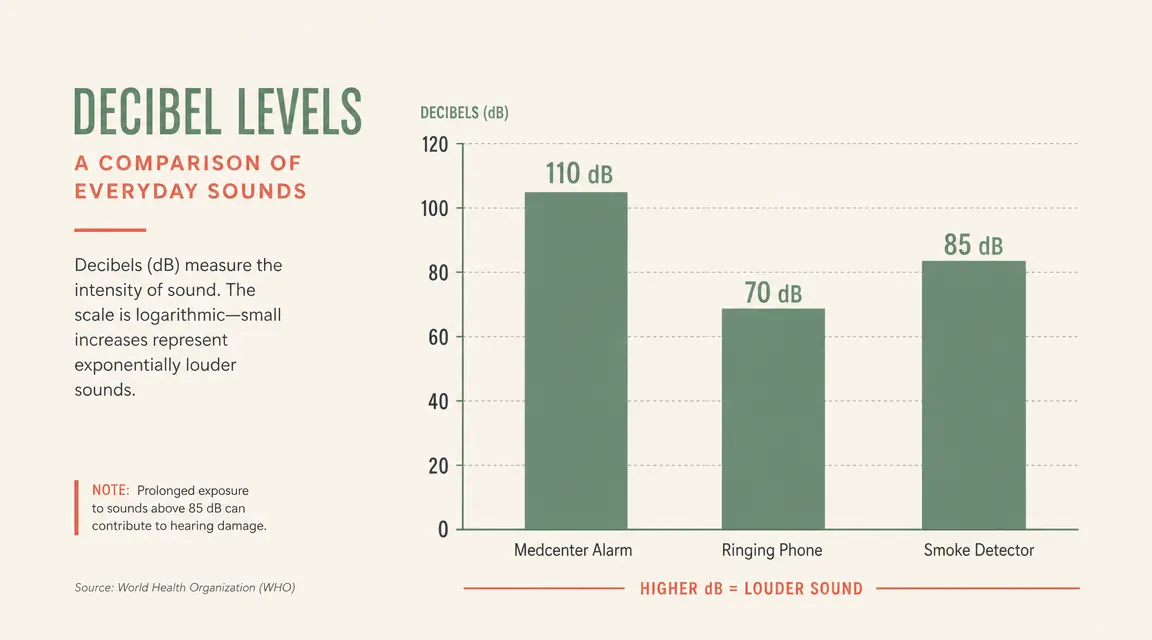
This is the section that motivated me to write this review at all. When caregivers imagine a talking alarm pill organizer, they often imagine something with the volume authority of a smoke detector or a phone ringing in another room. The Medcenter alarm is not that. The talking clock announces the alarm in a clear, measured voice at a volume I would estimate at roughly 70 to 75 decibels when measured close to the unit. That is about as loud as a normal conversation across a table. It is audible in a quiet room. It is not audible from two rooms away with a television on at normal volume.
If your parent has even mild hearing loss and keeps the organizer in the kitchen while they watch television in the living room, the alarm may not reach them. That is worth thinking through before you buy.
The practical implication: the organizer needs to be placed in the room where your parent spends most of their time, not in the kitchen because that is where medications belong. We keep Mom's on her side table in the living room. The medications travel from the organizer to her. Not the other way around. If the only viable placement for your parent is down the hall from where they sit during the day, this alarm may not reliably reach them. For those situations, I would supplement with a phone alarm as a backup. The Medcenter cannot increase its own volume, and there is no volume adjustment dial.
One positive note on the voice itself: the announcement is warm and clear, not robotic or jarring. The clock says something like a calm reminder to take medication. For seniors who get startled by sudden sharp sounds, the talking voice is genuinely better than a beeping alarm. My mother likes it. She calls it her reminder friend, which I find charming and also confirms she actually responds to it.
Battery Life: The Real Timeline
The Medcenter clock module runs on three AA batteries. The marketing language implies long life. Real-world use among caregivers who have reviewed this product suggests three to four months of battery life with four alarms sounding daily. The clock speaking for every alarm and every button press drains batteries faster than a silent timer would. This matters for two reasons.
First, if you are managing your parent's medications from a distance, a dead battery means silent alarms. The clock does not send you a notification that batteries are low, because it is not connected to anything. It simply goes quiet. Your parent may not notice for a day or two. In an eight-medication regimen that includes a blood thinner or a heart medication, a day of silent alarms is a real clinical risk. Build a calendar reminder for battery replacement every 90 days. Do not rely on your parent to tell you when the clock sounds different.
Second, the battery replacement process requires removing the clock module from the organizer base, and if 31 filled trays are sitting in the base, the whole assembly is heavier and more awkward than it looks in photos. Keep a set of AA batteries in the same drawer as the organizer. I tape a small sticky note to the back of the clock with the date I last replaced the batteries. Low tech, but it works.
The Price-Versus-CVS Question
At $89 at current price, the Medcenter is not a small purchase in the pill-organizer category. You can buy a standard weekly organizer at CVS for $6 to $9. You can buy a month-view organizer for $15 to $25. The honest question every caregiver should ask before spending $89 is: does my parent need the alarm and talking features, or am I buying those features because they make me feel better?
Here is the clinical answer: if your parent reliably takes their medications on their own with a simple organizer, a $9 CVS box is sufficient. If they are missing doses, taking doses at wrong times, or unable to tell you whether they took their morning medications, an alarm organizer earns its price immediately. One missed dose of certain cardiac medications or blood thinners can mean an ER visit. The Medcenter cost is modest compared to a single emergency copay. But it only earns that comparison if your parent actually responds to the alarm. Which brings me to the most important limitation.

Who Should Not Use This Product
The Medcenter is not designed for and does not work reliably for seniors with moderate to advanced dementia or significant cognitive impairment. I want to be very specific here because I have seen caregivers frustrated after purchasing this expecting it to solve a problem it cannot solve.
The talking alarm requires the user to (a) hear the alarm, (b) understand it is a medication reminder, (c) locate the organizer, (d) identify the correct compartment for the current time of day, and (e) take only the pills in that compartment. Each of those steps requires executive function that dementia erodes. A person in moderate cognitive decline may hear the alarm, feel reassured something is handling it, and never take the medication. They may take pills from the wrong time slot. They may take the entire week of one medication from the tray. The alarm provides false reassurance to the caregiver while the system breaks down invisibly.
For memory-impaired seniors, medication management requires human oversight at every dose, a pharmacy blister pack service, or an automatic dispensing machine that locks all compartments except the current dose. The Medcenter is none of those things. It is a well-designed tool for a person who is cognitively intact but forgetful, distracted, or overwhelmed by a complex schedule. That is a large population. It is not the entire population of seniors on multiple medications.
Who This Is For
The Medcenter monthly pill organizer is the right product for a senior who is fully cognitively intact, manages their own life independently, and is missing medications primarily because of distraction, busy days, or the genuine difficulty of remembering four different time slots across six or more medications. It is also well-suited for a caregiver who fills and manages the organizer for a mostly independent parent, because the 31-day format turns a weekly chore into a monthly one. My mother fits this profile exactly: sharp, independent, annoyed at being managed, but genuinely unable to track her cardiac schedule without the alarm. The organizer gives her ownership of the process. She responds to her alarm. She takes her pills. I get to be her daughter instead of her medication supervisor.
What I Liked
- 31-day format means one refill session per month, not four
- Four daily alarm slots handle even complex multi-dose schedules
- Warm talking voice is less startling than a beeping alarm, especially for hearing-sensitive seniors
- Clear, color-coded tray system reduces confusion about which time slot to take
- Durable build; after 14 months our unit has had no mechanical issues
- Tray system makes it easy to verify visually whether a dose was taken
Where It Falls Short
- Alarm volume will not carry through walls or over a television; placement matters more than most reviewers acknowledge
- Setup programming is genuinely difficult the first time; read or watch a guide before touching the buttons
- Batteries need replacing every 90 days or so; no low-battery alert means alarms can silently fail
- Not suitable for seniors with moderate or advanced cognitive impairment
- At $89 it is a considered purchase; the $6 CVS box outperforms it for seniors who already self-manage reliably
Who Should Skip It
Skip the Medcenter if your parent has any degree of dementia, significant memory impairment, or confusion about time and daily routines. The alarm will not compensate for those conditions, and the open tray format creates a real risk of accidental double-dosing or taking the wrong time slot. Skip it also if your parent already reliably self-manages a simpler organizer. You are not solving a problem. And skip it if your parent lives in a large home and the organizer cannot be placed in the room where they spend most of their waking hours. A missed alarm is a missed dose, regardless of how sophisticated the organizer is. For a deeper comparison of this product against a simpler weekly option, see our full breakdown in the article on talking pill organizers versus simple weekly pillboxes.
If you are in a situation where cognitive impairment is already present or progressing, the most useful next step is a conversation with your parent's prescribing physician about a pharmacy blister pack service, which many insurance plans cover and which removes the user-action requirement entirely. I have recommended this path to patients in our office for years. The Medcenter is excellent technology for a specific need. Knowing when that need applies is the whole job.
You can read the story of how our family handled a specific missed-dose crisis with Dad's blood thinner, and what we did next, in our piece on how a pill organizer alarm protected a critical cardiac medication regimen. It gives more context for exactly the type of situation where this product earns its price.
If your parent is cognitively intact but missing doses on a complex schedule, this is the product that closes that gap.
The Medcenter 31-day talking alarm organizer is the most complete non-pharmacy solution for multi-medication seniors who can still self-manage with a reliable prompt. One monthly fill session. Four daily alarms. A warm voice that reminds instead of startling. Check today's price and read the other verified reviews before you decide.
Amazon Check Today's Price on Amazon →