
If you only do one thing today, get a sturdy shower chair. A DMI 360 swivel shower chair (the model I keep recommending) is the single biggest reduction in fall risk you can buy.
The bathroom is the most dangerous room in your parent's home. That is not a scare tactic , it is what the CDC data shows, and it is what I see confirmed over and over in the medical office where I work. Most falls in older adults happen at home, and a large share of those happen in the bathroom, where wet surfaces, awkward postures, and the effort of stepping over a tub edge combine in the worst possible way. If you are reading this because someone already had a close call, I want you to know that the checklist below covers every change that actually makes a measurable difference. None of it requires a contractor. Most of it can be done in a single afternoon.
I have made these changes for my own mother, who is 81 and still showers independently most mornings. Getting her bathroom right took about three separate shopping trips over two months because I kept adding pieces as I learned what she actually needed. I am going to save you that trial and error. Work through these seven steps in order and you will cover the bathroom thoroughly without spending money twice.
Your parent should not be white-knuckling it through every shower. The DMI 360 Swivel Chair eliminates the single biggest fall risk: the transfer.
The DMI 360 Max Comfort Swivel Shower Chair has a 360-degree swivel seat and padded armrests so your parent can sit down outside the stream and rotate in safely. 8,000+ reviews. Rated 4.2 stars. The chair we use.
Amazon Check Today's Price on Amazon →Step 1: Remove the Rugs and Runners Outside the Shower
This is the step nobody wants to do first because the rugs feel homey and safe. In practice, any loose bath rug with a folded edge or a worn-out non-slip backing is a trip hazard that undoes everything else you install. Start here before you buy anything. Pull up every loose mat, runner, and decorative rug in the bathroom. Set them aside. If your parent insists on something underfoot, the only acceptable option is a low-pile mat with high-quality suction-cup backing that you press firmly into place every single time it is washed. Otherwise, the clean tile floor is genuinely safer.
While you are doing this, note the clear path from the bedroom door to the toilet to the shower. That corridor needs to stay clear every night, not just when company is coming. A small wastebasket repositioned, a stool moved to the corner, an extension cord rerouted: these details matter at 3am when your parent is half-asleep.
Step 2: Add Grab Bars Where the Weight Is Actually Placed
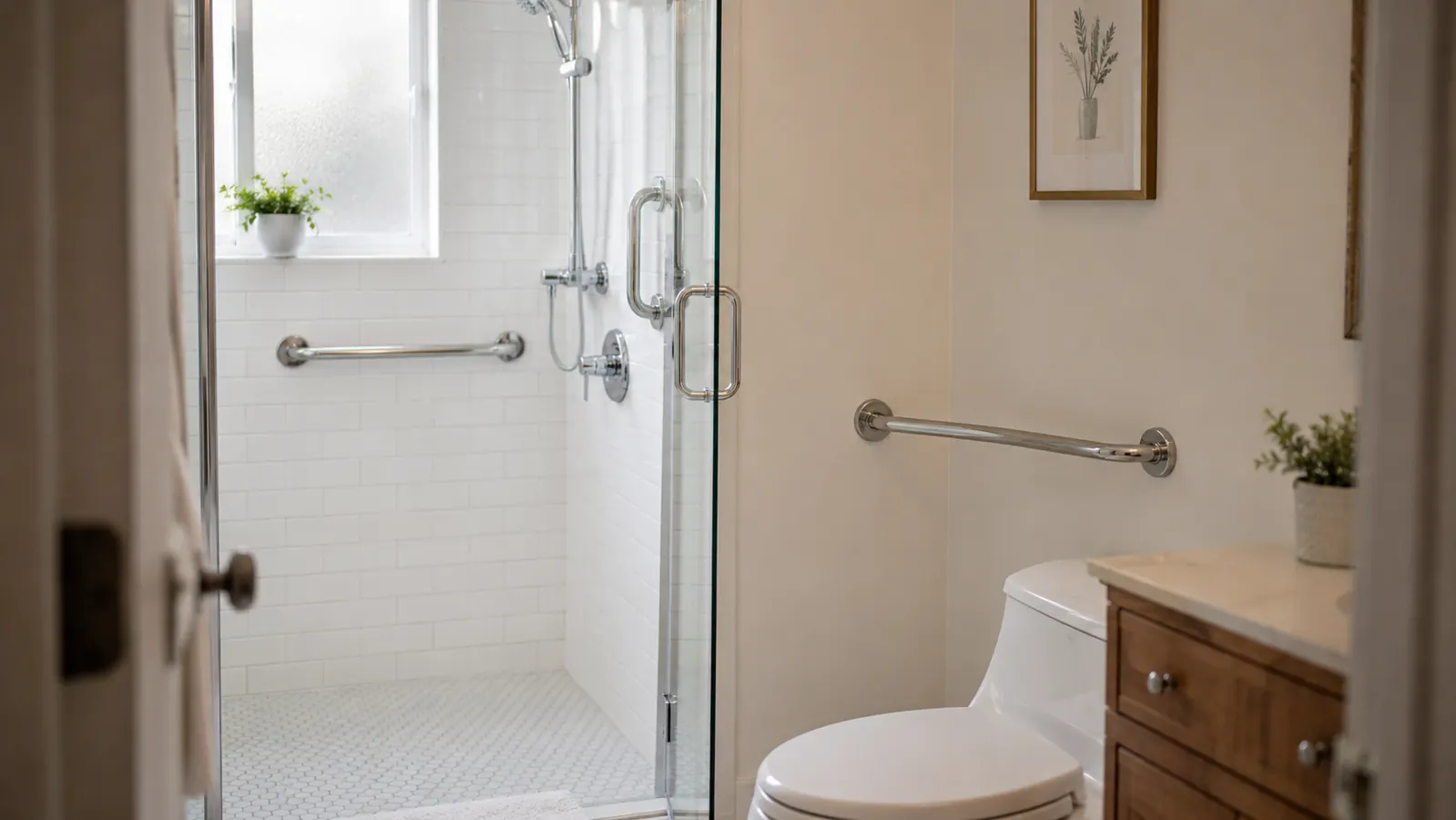
Grab bars are the highest-return investment in bathroom safety, but they are only useful if they are mounted where a person's hand naturally reaches during the most vulnerable moments: entering the shower, lowering to a seat, and standing back up. Those moments are not all at the same height or the same wall. A standard setup for a walk-in shower includes a vertical bar at the entry point (where your parent first steps in), a diagonal or horizontal bar on the shower wall at sitting height, and a bar beside the toilet if there is one in the same space.
Grab bars must be anchored into wall studs or into blocking behind the drywall. A towel bar screwed into drywall alone will pull free under real body weight, and that failure is catastrophic. If your parent's bathroom has tile, you can rent a tile drill bit, locate the studs with a stud finder, and mount the bars yourself in about 90 minutes. If that feels outside your skill set, a handyman can do it in a single visit. Do not skip this step because it feels complicated. Suction-cup grab bars are not an acceptable substitute for a permanent parent who showers daily.
Step 3: Install a Non-Slip Mat Inside the Shower
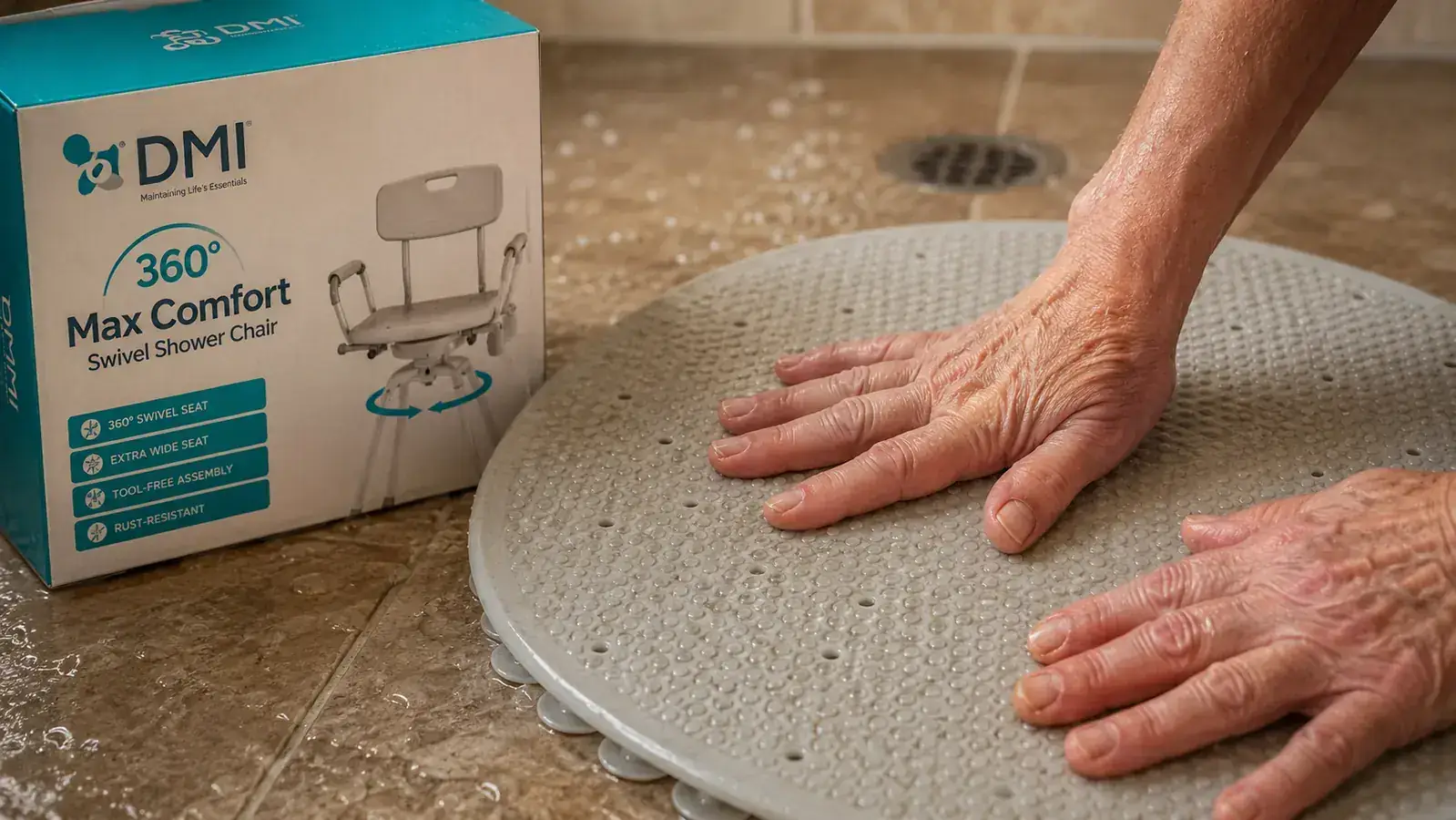
Once your parent steps inside the shower, the floor itself becomes the risk. Wet tile and wet fiberglass are both surprisingly slippery, especially with soap involved. A textured non-slip mat with strong suction cups covers the standing zone directly under the showerhead. Look for mats with drainage holes so water does not pool, and choose one that reaches edge-to-edge on the floor you have. A mat that ends six inches short of the shower wall leaves a slippery strip right where someone shifts their weight to turn around.
Clean the mat weekly. Suction cups lose grip when soap scum builds up underneath them, and a mat that slides even slightly defeats its purpose. This is a $15 to $30 purchase and takes about two minutes to put in place, but it needs to be maintained to stay effective.
Step 4: Add a Shower Chair So Your Parent Never Has to Stand the Entire Time
This is the step most families resist the longest and regret delaying the most. Standing in a warm shower is fatiguing for everyone. For an older adult with mild balance issues, reduced leg strength, or any orthostatic hypotension (blood pressure that drops when standing), it is genuinely risky. A shower chair changes the equation completely: instead of managing balance on a wet surface for 10 to 15 minutes, your parent sits and washes. The fall risk collapses.
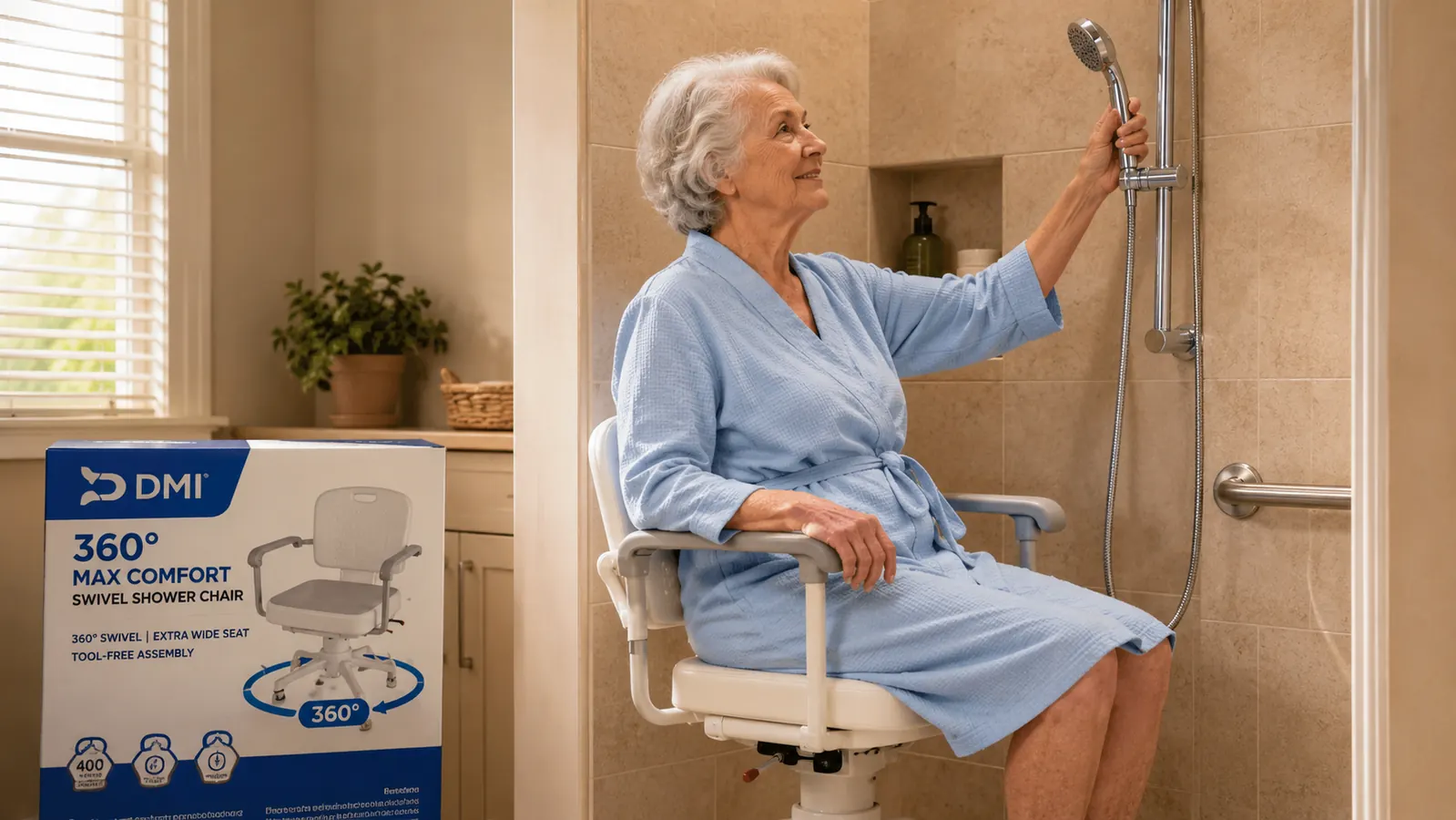
If your parent is still fully mobile and stepping in and out without difficulty, a basic no-frills shower bench works fine. But if the transfer itself, the act of stepping in and sitting down, is where the risk lives, you need something with a swivel seat. The DMI 360 Max Comfort Swivel Shower Chair is what we use for my mother. It has a padded seat that rotates 360 degrees, so she can sit down on the outside edge of the transfer zone, swing her legs in, and never has to step in while also lowering herself. For someone with hip stiffness or arthritis in the knees, that sequence matters a great deal. The chair holds up to 360 pounds, has padded armrests she actually uses, and has been in daily service for eight months without any wobble or squeaking.
It is not a cheap chair. At its current price it is the most expensive item on this list. But a single ER visit for a hip fracture costs more in every currency you can name, and the chair is what actually closes the gap between "Mom is careful" and "Mom is safe." If you want the full long-term review before committing, I have written one: see our DMI swivel shower chair long-term review. If you are deciding between this and a basic bench, our swivel chair vs basic bath bench comparison walks through exactly who needs which.
The transfer is where the fall happens. Not standing in the shower and not drying off. The moment of stepping in while also lowering yourself onto a seat is the one that sends people to the ER.
Step 5: Replace the Fixed Showerhead with a Handheld Slide Bar Unit
A fixed showerhead requires your parent to move their body to rinse every part of themselves. A handheld showerhead on a slide bar does the opposite: the water goes where it is needed, and your parent stays seated and still. This is a simple plumbing swap that requires no tools beyond an adjustable wrench, and most slide bar kits include everything needed to connect to the existing arm. Budget $35 to $70 for a quality unit. Look for a hose at least 60 inches long so the head reaches all the way to the chair without pulling taut.
When your parent is seated on a swivel chair and holding a handheld showerhead, they are in control of the water, their feet stay planted, and they are not twisting to rinse their back. That combination of seated stability plus directed water flow is what makes the chair and the handheld head a system rather than two separate items. Install both. The chair does the structural safety work. The handheld head makes sitting comfortable enough that your parent will actually use the chair instead of standing anyway.
Step 6: Set the Water Heater to 120 Degrees Fahrenheit or Below
This takes thirty seconds and prevents scalds. The standard hot water heater setting in most homes is 140 degrees, which is hot enough to cause a serious burn in under five seconds. Older adults often have reduced temperature sensitivity in their skin, meaning they may not feel the warning discomfort before damage occurs. They may also respond more slowly if the water turns unexpectedly hot during a shower. Setting the water heater to 120 degrees eliminates this risk while still providing a comfortably warm shower. Check the dial on the side or front of the tank, labeled Low, Medium, Hot, or A, B, C. Setting it to the 120-degree notch is usually the medium position.
If your parent lives alone and turns the hot water up because they like very warm showers, consider a thermostatic mixing valve installed at the shower itself. A plumber can add one in about an hour. It caps the maximum shower temperature regardless of what the heater is set to.
Step 7: Fix the Lighting and Add a Nightlight on the Path to the Bathroom
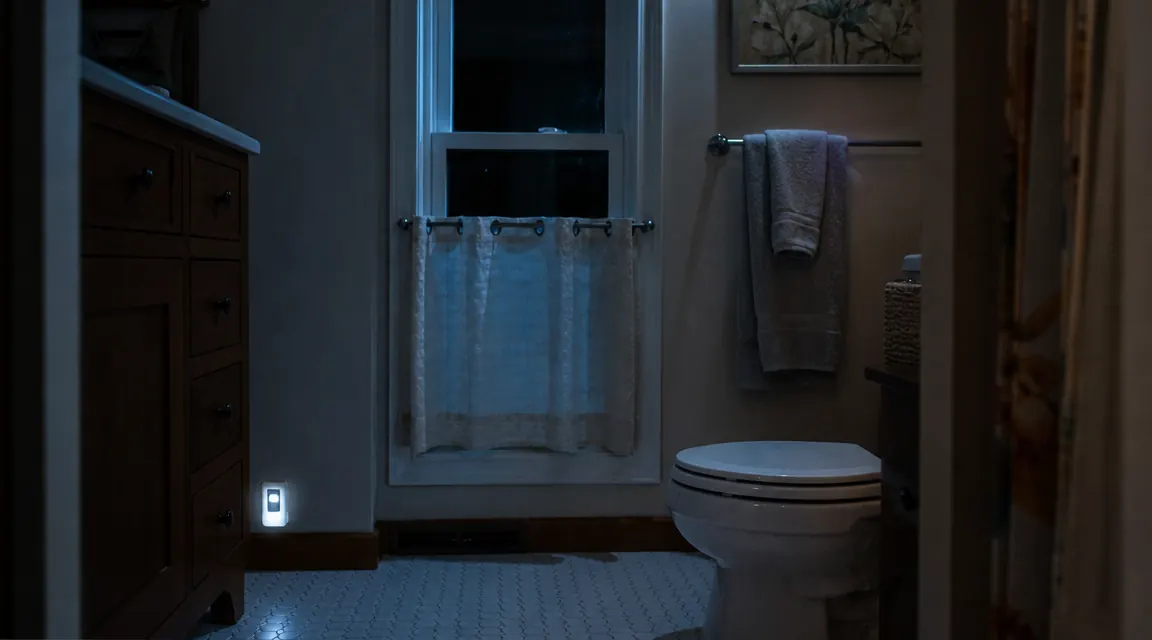
Poor lighting is an invisible fall risk because it is easy to dismiss. Your parent has navigated that bathroom for decades, so they feel confident in the dark. But visual acuity changes with age, night vision degrades, and the combination of dim light plus a wet floor plus the disorientation of being half-asleep is genuinely dangerous. Replace any single overhead bulb with a bright LED (at least 800 lumens for a bathroom). Add a plug-in LED nightlight in the bathroom itself and at least one more in the hallway between the bedroom and the bathroom. These cost about $8 each and require no installation beyond plugging them in.
Motion-activated nightlights are even better because they do not stay on all night and startle your parent when they trigger. Look for ones with a lux sensor that only activate in darkness. Put one at ankle height near the bathroom door so the floor is lit before your parent reaches the light switch.
What Else Helps
Two additional items are worth mentioning that do not fit neatly into a single step. First, a toilet safety frame or raised toilet seat with handles belongs in the same project window as the shower work. Getting on and off the toilet is mechanically similar to the shower transfer, and falls there are equally common. Second, if your parent takes any medications that cause dizziness, light-headedness, or low blood pressure, ask their prescriber or pharmacist whether the timing can be adjusted so the peak effect does not coincide with the morning shower. This is a conversation that takes five minutes in a scheduled call and can meaningfully reduce risk. I raise this from the medical office side, not the caregiver side: medication timing and fall risk are discussed less often than they should be.
If you are only going to do one thing on this list today, make it the shower chair.
The DMI 360 Max Comfort Swivel Shower Chair is the item that actually closes the transfer gap. Padded, 360-degree swivel, 360 lb capacity, and the thing we use every morning. Over 8,000 Amazon reviews. Check current availability before the next shower.
Amazon Check Today's Price on Amazon →