

Here is the short answer: if your parent walks into a standard walk-in shower under their own power and just needs somewhere safe to sit, a basic bath bench will probably do the job. But if your parent has a standard tub-shower combo, uses a walker or cane, has one-sided weakness from a stroke, or needs your hands-on help to get in and out, a basic bench is the wrong tool entirely. That is the distinction nobody explains on the product listing page, and it is the reason so many families buy a $30 bench, return it three weeks later, and then spend the money they should have spent the first time.
I have spent twenty-plus years in medical office management, and I have been my mother's primary caregiver since her hip replacement in 2023. The bathroom is where I have seen the most anxiety, the most improvised workarounds, and unfortunately the most falls. A shower chair looks simple. The decision is not. Let me break down exactly how these two options compare, situation by situation.
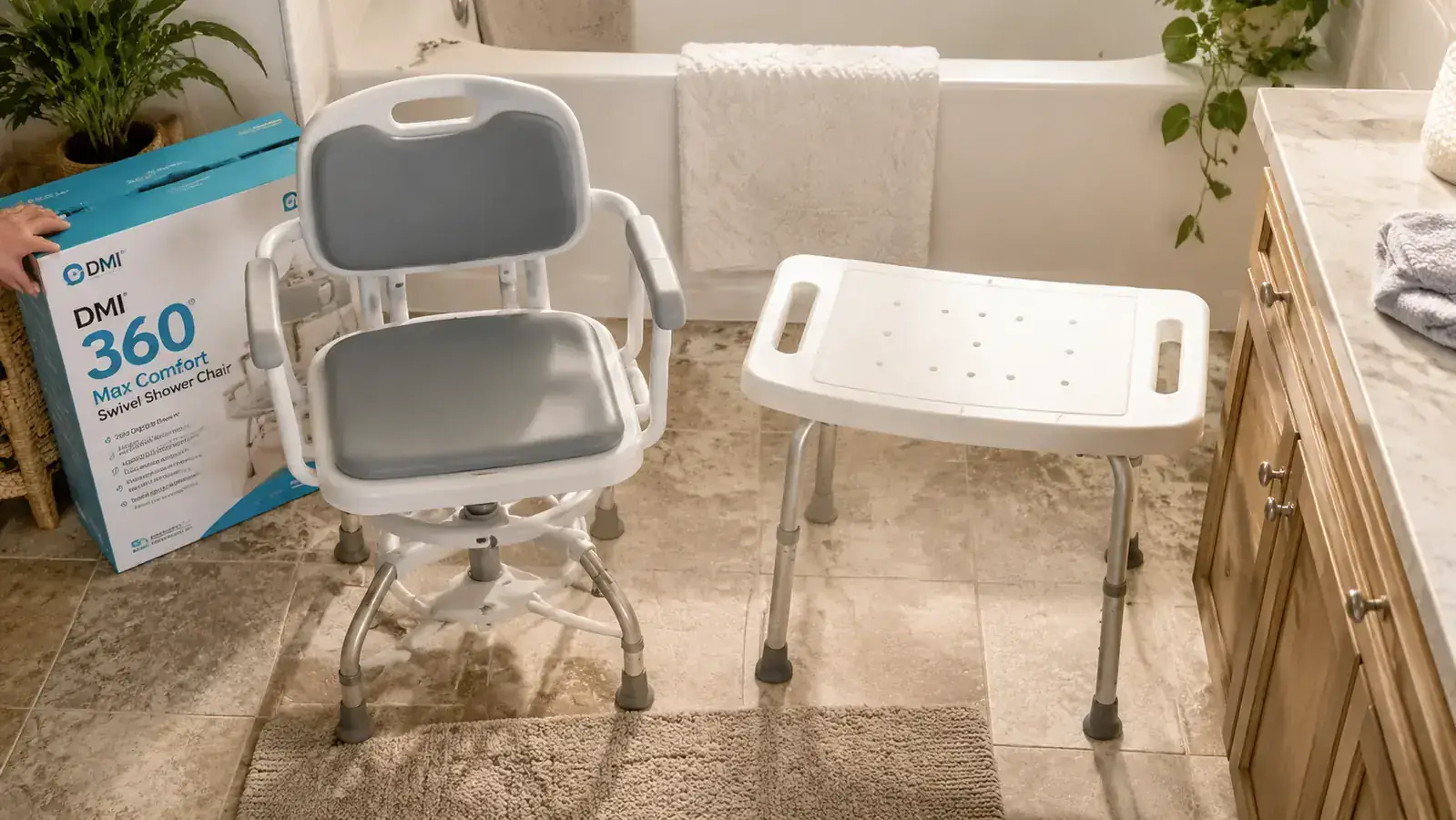
| Feature | DMI 360 Swivel Shower Chair | Basic Bath Bench |
|---|---|---|
| Price range | Around $210 | Around $25 to $45 |
| 360-degree swivel seat | Yes | No |
| Weight capacity | 360 lbs | Typically 250 to 300 lbs |
| Padded seat and back | Yes, contoured padding | No, hard plastic |
| Works with standard tub | Yes, designed for tub transfer | Difficult and unstable |
| Works in walk-in shower | Yes | Yes |
| Armrests for push-up assist | Yes, full armrests | Some models, not all |
| Non-slip feet | Yes | Typically yes |
| One-sided assist (caregiver) | Much easier, due to swivel | Requires awkward repositioning |
| Assembly required | Yes, 20 to 30 minutes | Minimal, 5 to 10 minutes |
| Recommended for stroke / hip surgery recovery | Yes | Not typically recommended |
Where the DMI 360 Wins: The Tub Transfer Problem
The single biggest dividing line between these two products is what happens at the tub ledge. A standard American bathtub has a ledge that is typically 15 to 18 inches high. For an elderly adult with stiff hips, weakened legs, or any balance impairment, swinging one leg over that ledge while the floor is wet and the tub is slippery is one of the most dangerous moments in their entire day. A basic bath bench straddled across the tub ledge gives them something to sit on, but it does not solve the rotation problem. Your parent still has to hoist both legs over the rim, which requires strength and hip flexibility that many aging adults simply do not have.
The DMI 360's swivel seat changes the whole transfer. Your parent sits down on the seat while it is positioned outside the tub, then rotates 360 degrees so their body swings over the ledge and they are now facing into the shower. Their feet follow. The legs never have to lift as high, the core never has to twist, and you as the caregiver are guiding a controlled seated pivot rather than spotting a precarious standing transfer. For my mother after her hip replacement, this was the only method her physical therapist would approve for home bathing. The surgeon's discharge instructions literally said no standard tub transfer without assistive equipment.
The 360 lb weight capacity also matters more than people expect. Standard bath benches are rated at 250 to 300 lbs, which sounds like plenty until you factor in the dynamic load of a person shifting weight during a transfer. The DMI's higher rating gives you a structural safety margin that a basic bench simply cannot match.
Where the Basic Bath Bench Wins: Walk-In Showers and Independent Users
If your parent lives in a home or apartment with a walk-in shower, no tub ledge to negotiate, and they are mobile enough to step in and position themselves, a basic bench is completely legitimate. It is lighter, easier to move, takes up less space, and costs a fraction of the price. For a parent who is mildly unsteady but fundamentally independent, a simple bench plus a good grab bar and a non-slip mat may be all they need. Buying the DMI in that scenario is buying capability you will never use.
Basic benches also win on portability. They fold or break down quickly, making them practical for travel or for parents who split time between homes. If your mother goes between her house and your house regularly, a $30 bench she can throw in a bag is more practical than a $210 assembly-required chair that lives in one bathroom.
If Dad has a standard tub and needs help getting in, this is the chair that makes that transfer safe.
The DMI 360 Max Comfort Swivel Shower Chair has a 360-lb capacity, padded contoured seat, full armrests, and the swivel mechanism that changes everything about the tub-transfer process. Rated 4.2 stars across 8,100-plus reviews.
Amazon Check Today's Price on Amazon →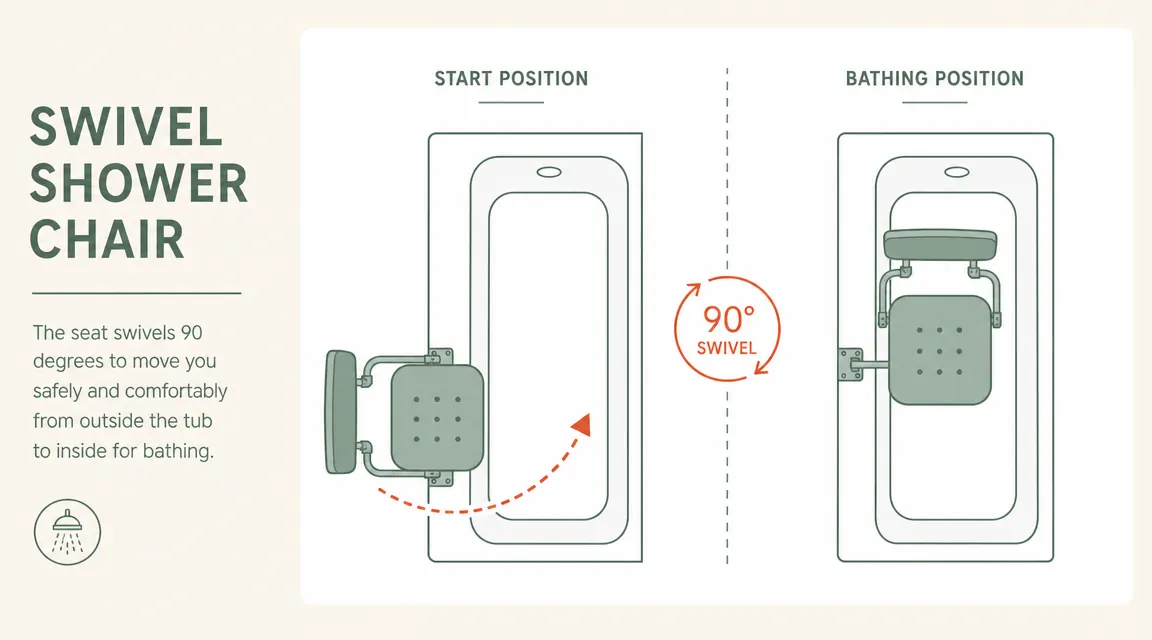
The Swivel Matters More Than You Think
I want to spend a moment on the swivel function specifically, because it is easy to dismiss as a premium gimmick until you have actually helped an elderly parent in and out of a bathtub. What the rotation does, practically speaking, is allow the person to stay seated through the entire transfer. There is no moment where they are standing on one leg over a wet tub floor. There is no moment where you are trying to hold their weight while they awkwardly swing their second leg over a wall. The transfer has a beginning, a middle, and an end, and the person is seated for all of it.
The transfer has a beginning, a middle, and an end, and your parent is seated for all of it. That is what changes the risk calculation entirely.
For caregivers, this matters as much as it does for the person being cared for. One of the most common caregiver injuries is a back strain that happens when you are trying to support someone mid-transfer in an awkward position. When the person is seated and pivoting, you are guiding, not catching. That is a fundamentally different physical demand on your body. If you help your parent bathe two or three times a week, that difference compounds over months.
What the Padding and Armrests Actually Do
Basic bath benches are hard plastic. For a thirty-minute shower, that is tolerable. For someone who moves slowly, who may take longer to bathe due to limited flexibility, or who has thin aging skin prone to pressure discomfort, hard plastic becomes genuinely uncomfortable. The DMI's padded, contoured seat is not a luxury feature. It is a reason your parent will actually use the chair consistently instead of skipping showers because sitting feels unpleasant.
The full armrests serve a dual function. First, they give your parent something to push against when standing up, which is where many falls happen. A surprising number of bathroom falls occur not during the transfer in, but during the stand-up at the end of the shower, when muscles are warmer but fatigue has set in. Second, the armrests give the caregiver a fixed point to hold and guide during transfers. When you are moving someone who is wet, that kind of structural anchor matters.
Assembly and Setup: What to Know Before It Arrives
The DMI 360 requires assembly, and most reviewers estimate 20 to 30 minutes. The instructions are clear but the piece count is higher than you expect from a shower chair. Give yourself a full half hour the first time, ideally with a second person. The basic bath bench assembles in five to ten minutes with one person. If you are in a hurry to set something up before Dad comes home from the hospital, that time difference may matter.
One practical note on fit: the DMI 360 is designed to straddle a standard American tub ledge. Measure your tub ledge width before ordering. The chair's legs need to clear the ledge on both sides, and most standard tubs are fine, but some older clawfoot tubs or tiled surround configurations may require a closer look. The product page includes dimension specs, and DMI's customer support is responsive to fitment questions.
Who Should Buy Which
Buy the DMI 360 Swivel Shower Chair if your parent has a standard tub-shower combination, if they have had a recent hip surgery or stroke, if they use a walker or cane, if their balance is noticeably compromised, if they need hands-on caregiver assistance for bathing, or if they are above 250 lbs. Any one of those factors tips the scale. If several apply, the decision is easy.
Buy a basic bath bench if your parent has a walk-in shower with no ledge to negotiate, if they are primarily independent in their bathing, if their balance concerns are mild rather than significant, or if portability between locations is a real priority. A basic bench is not a lesser product in those scenarios, it is simply the right tool for a different situation.
If you are genuinely unsure which category your parent falls into, ask their primary care physician or physical therapist. In my experience, that conversation takes five minutes and saves families from a costly return. Most doctors are glad to give a quick equipment recommendation if you just ask. They are less likely to bring it up unprompted because it is not always top of mind during a rushed appointment, but it is absolutely within their scope.
The DMI 360 is the right call if tub transfers are part of your routine and falls are your real concern.
Get the DMI 360 Max Comfort Swivel Shower Chair. Padded seat, full armrests, 360-degree swivel, 360 lb capacity. Built specifically for the tub transfer that trips up basic benches entirely. Read the full long-term review to see what 8 months of daily use looks like.
Amazon Check Today's Price on Amazon →