

Mom had two bathroom slips in the same month. Neither of them was a fall-on-the-floor emergency, but both were the kind that leave your hands shaking afterward. She would pivot off the tub edge, catch herself, and I would hear about it hours later. I work in a medical office. I have seen what happens when the third slip does not end as quietly as the first two. So I stopped waiting.
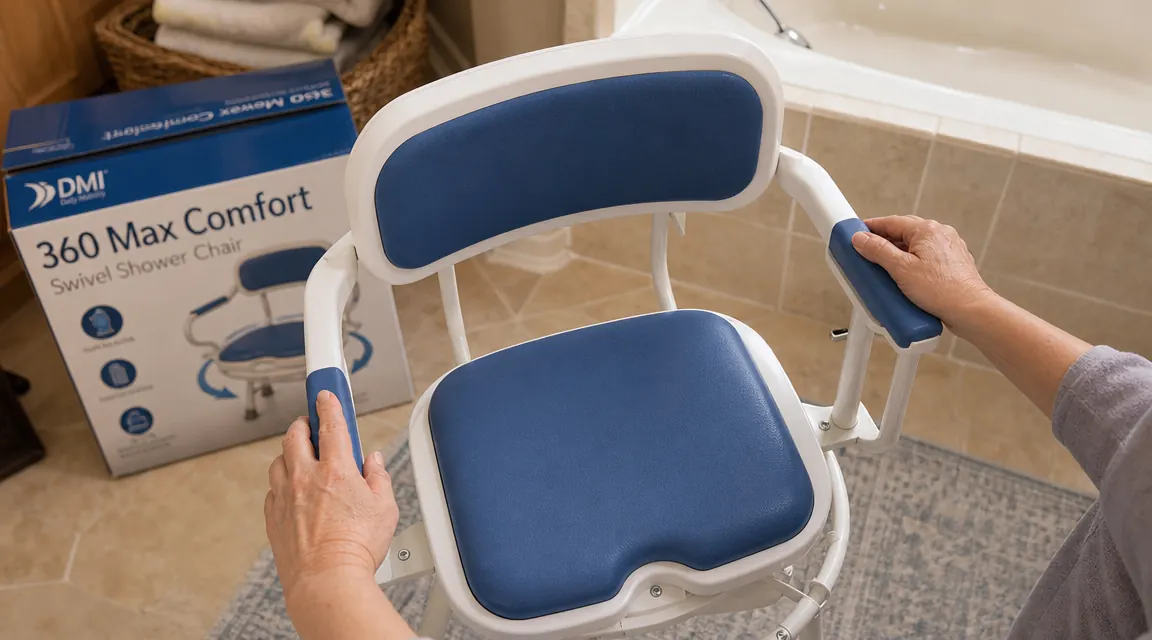
I spent about three evenings researching shower chairs before landing on the DMI 360 Max Comfort Swivel Shower Chair and Transfer Bench. The price gave me pause, I will be honest. At around $210 it is not the kind of thing you add to a cart without thinking. But it has been eight months since I installed it in Mom's bathroom, she uses it every single day, and I can tell you exactly what still works well, what required adjustment, and one part of the assembly process that the instructions do not adequately warn you about.
The Quick Verdict
A genuinely well-engineered shower transfer chair that solves the right problem. The swivel function works exactly as intended, the padding is real, and it has held up over eight months of daily use without loosening. Assembly takes patience and a second set of hands. Worth it for caregivers managing a parent with limited hip mobility or balance concerns.
Amazon Check Today's Price →If a bathroom slip is already on your radar, waiting costs more than the chair does.
The DMI 360 Swivel Shower Chair is available on Amazon with current pricing, free returns, and typically fast delivery. If you are in caregiver mode right now, this is the one I would send you to.
Amazon Check Today's Price on Amazon →How I Have Used It Over 8 Months
My mother is 79 years old, 143 pounds, and has moderate arthritis in both hips. Her tub is a standard 5-foot alcove with a fixed showerhead on the left wall. She showers every morning without exception, which is not unusual for her generation, and she values doing it herself. That last part matters more than people sometimes realize when you are shopping for assistive equipment. A product that embarrasses or infantilizes a parent tends to disappear under the bathroom sink inside two weeks.
The DMI chair sits with two legs inside the tub and two legs outside. Mom sits on it from the outside, rotates the seat 90 degrees to face into the shower, and swings her legs over the tub wall one at a time. No standing pivot, no awkward shuffle. After about four days she had the motion down without thinking about it. That routine has not changed in eight months.
I check the chair about once a month, tighten any bolts that have worked loose (a normal expectation with any aluminum-frame bath equipment), and wipe the seat pad and armrests with a mild cleaner. Nothing has cracked, deformed, or corroded. The swivel mechanism has no perceptible wobble compared to month one. For a chair that gets daily wet contact, that is the thing I am most pleased about.
The Swivel Function: What It Actually Feels Like
This is the feature you are paying for, so it deserves a clear answer. The seat rotates on a center post with a detent click at 0 degrees (facing out of the tub) and at 90 degrees (facing the showerhead). In practice it moves smoothly but with enough resistance that it does not drift on its own. A person can initiate the rotation by pressing their feet lightly on the floor and shifting their weight, or a caregiver can rotate it from behind. The detent locks are reassuring without being hard to disengage.
What the swivel does not do is substitute for handholds. Mom still uses a grab bar I installed on the shower wall for the moment she lifts her second leg over the tub edge. If your parent cannot hold a grab bar or has significant upper-body weakness, the chair addresses the pivot problem but not the leg-lift problem. Those are two separate challenges and sometimes require two separate solutions. I cover this more in my related piece on swivel shower chair versus basic bath bench, where the comparison really comes down to what kind of transfer problem you are actually solving.
The swivel solved the part of the shower transfer that was keeping me up at night. The pivot off the tub edge, standing on one leg, trying to turn. That part is simply gone now.
Assembly: The Part That Trips People Up
I want to be straightforward here because the one-star reviews for this chair are almost entirely about assembly, and having done it myself I can confirm the complaints are legitimate. The instructions are thin for a chair with this many components. You are working with two distinct leg frames (inside-tub and outside-tub), a center swivel post, padded armrests, a footrest, and leg levelers on all four legs. The order of operations matters and the instructions do not spell it out clearly enough.
My recommendation: do not do this alone. Have a second person hold the frame while you attach the cross braces. Plan for 45 to 60 minutes, not the 20 the box implies. Read through all the instructions before touching a single bolt. And before you put any weight on it, sit on it yourself first over carpet, check every bolt, then move it to the bathroom. The chair is sturdy once it is correctly assembled. Getting to correctly assembled requires more patience than the packaging admits.
One practical note: the leg levelers are more important than they look. Most bathrooms have a slight floor slope toward the drain. Spend the extra five minutes getting them right. An unlevel chair does not rock dangerously, but it adds a subtle psychological unsteadiness that you do not want your parent to feel the first time they sit down.

Padding and Comfort Over Time
The seat pad and armrests are made from a closed-cell foam covered in a textured vinyl. After eight months of daily wet contact I expected some degradation, and there is some, though less than I anticipated. The seat has softened slightly and the surface texture has smoothed out in the center where Mom sits, but neither pad is cracked, peeling, or retaining water. The armrests still provide meaningful cushioning during transfers.
I will add one honest note: the seat is wide and the padding is genuine, but it is not a spa cushion. For a parent who needs to sit for a full 10 to 15-minute shower, the padding is adequate. If your parent has skin fragility or pressure sensitivity and needs exceptional cushioning, you might consider a supplementary gel pad. That said, I have not needed one for Mom.
Weight Capacity and Who This Is Built For
The DMI 360 is rated for 360 pounds. That is a meaningful number for a shower chair category that often caps at 250 or 300 pounds. The extra-wide seat design, roughly 20 inches across, reflects the same thinking. This chair was clearly designed with bariatric and plus-size users in mind, and the structural engineering backs that up. The frame is aluminum, which resists corrosion and keeps the weight manageable, but the joints are reinforced in a way you can see and feel.
If your parent is under 250 pounds and has no significant mobility limitation beyond some general unsteadiness in the shower, there are lighter and less expensive options. I outline those tradeoffs in my piece on why a shower chair is worth it for aging parents, including the cases where a $40 basic bench genuinely solves the problem just as well. The DMI earns its price for parents with hip replacement history, significant arthritis affecting the pivot motion, or weight above 250 pounds.
What I Liked
- Swivel mechanism works exactly as described and has not loosened over 8 months
- 360-pound capacity with an extra-wide 20-inch seat handles a broader range of body types than most competitors
- Padded seat and armrests remain intact after daily wet use over multiple months
- Detent lock clicks at both positions so the seat does not drift mid-transfer
- Aluminum frame is lightweight enough to reposition for cleaning, corrosion-resistant in wet use
- Adjustable leg levelers handle sloped shower floors
Where It Falls Short
- Assembly instructions are underpowered for the complexity involved; plan 45-60 minutes and get a second person
- At $210 it is a considered purchase, not an impulse buy
- Padding is adequate, not luxurious; very pressure-sensitive skin may want a supplementary gel pad
- 4.2-star rating on Amazon reflects real assembly frustration in the lower reviews, not product failure once assembled
- The outside-tub legs need clear floor space; does not fit every bathroom layout

Who This Is For
This chair is the right answer if your parent has limited hip rotation, has had a hip or knee replacement, or has balance concerns that make the standard stand-and-pivot shower entry genuinely risky. It is also right if they are above 250 pounds and the standard shower chair options feel undersized. And it is right if you are a caregiver who assists with bathing, because the swivel means you are assisting a seated transfer rather than managing a standing one.
The parent who will get the most from this chair is one who still has reasonable upper-body strength and can initiate or assist the swivel with their own hands. Total dependence on caregiver assistance is not a disqualifier, but it does shift the calculus toward whether a tub transfer bench or a roll-in shower conversion might be the bigger-picture solution.
Who Should Skip It
If your parent primarily uses a walk-in or barrier-free shower rather than a tub-shower combo, the transfer bench design of this chair is not what you need. The DMI 360 is built around the tub-entry problem specifically. For a roll-in shower or a walk-in shower stall, a fixed shower chair or a fold-down wall-mount seat will serve you better and cost less.
If bathroom space is extremely tight, measure carefully before ordering. The outside legs need a clearance of about 14 inches from the tub rim to the nearest obstacle, whether that is a toilet, a vanity, or a wall. And if your parent is resistant to assistive equipment in general, I would not start here. The learning curve on the swivel motion is small but real. Starting with something lower-stakes and then graduating to this chair is sometimes the better path.
Eight months in, I still think this is the right chair for what Mom needed.
If the tub-entry pivot is the problem you are trying to solve, the DMI 360 addresses it as well as anything I found at any price. Check today's price and availability on Amazon, where it typically ships within a few days.
Amazon Check Today's Price on Amazon →