

My mother called me on a Tuesday morning and told me she had caught herself on the kitchen counter again. Not a fall, thank goodness. But that near-miss was the third one in six weeks. I drove over that afternoon, and by the time I left we had agreed it was time to get her a rollator walker. Then I started shopping, and I realized I had no real idea what I was looking at. Four wheels, two wheels, 6-inch tires, 8-inch tires, loop brakes, trigger brakes. I work in a medical office and I still felt lost. That was fourteen months ago. Since then I have helped four other caregivers in our office pick rollators for their parents, and I have noticed the same confusion every time. This guide is what I wish someone had handed me.
The good news: rollator shopping is not as complicated as it looks online. There are five decisions that actually matter, and once you have worked through them in order, the right model will be obvious. The Drive Medical Rollator Walker is the one I ended up buying for my mother, and it is the one I most often recommend to others. But I want you to know why it fits before you click anything.
If your parent needs a walker now and you want to skip ahead, this is the one I recommend.
The Drive Medical Rollator has 50,000+ reviews, a 300-lb weight capacity, height-adjustable handles, and 6-inch wheels sized for indoor and light outdoor use. It covers most caregivers' needs out of the box.
Amazon Check Today's Price on Amazon →Step 1: Confirm the Weight Capacity You Actually Need
This is the first thing I check, and it is non-negotiable. Most standard rollators are rated to 250 or 300 pounds. A bariatric rollator goes to 400 or 500 pounds. If your parent's current weight is within 30 pounds of the stated capacity, size up. Rollators are load-rated at static weight. That means the frame is tested holding still weight, not the dynamic forces that happen when someone leans hard on the handles for balance during a stumble. You want real margin, not a number you barely squeak under.
The Drive Medical model is rated to 300 pounds. That covers the majority of adults comfortably. If your parent is over 270 pounds, I would look at Drive Medical's bariatric version instead. Do not try to stretch a 300-pound frame to 285 pounds for a person who grips and leans heavily. The frame will hold, but the welds stress and you may get wobble over time. For Mom, who is 5'4" and 142 pounds, the standard model is fine.
Step 2: Match Wheel Size to Where They Will Actually Use It
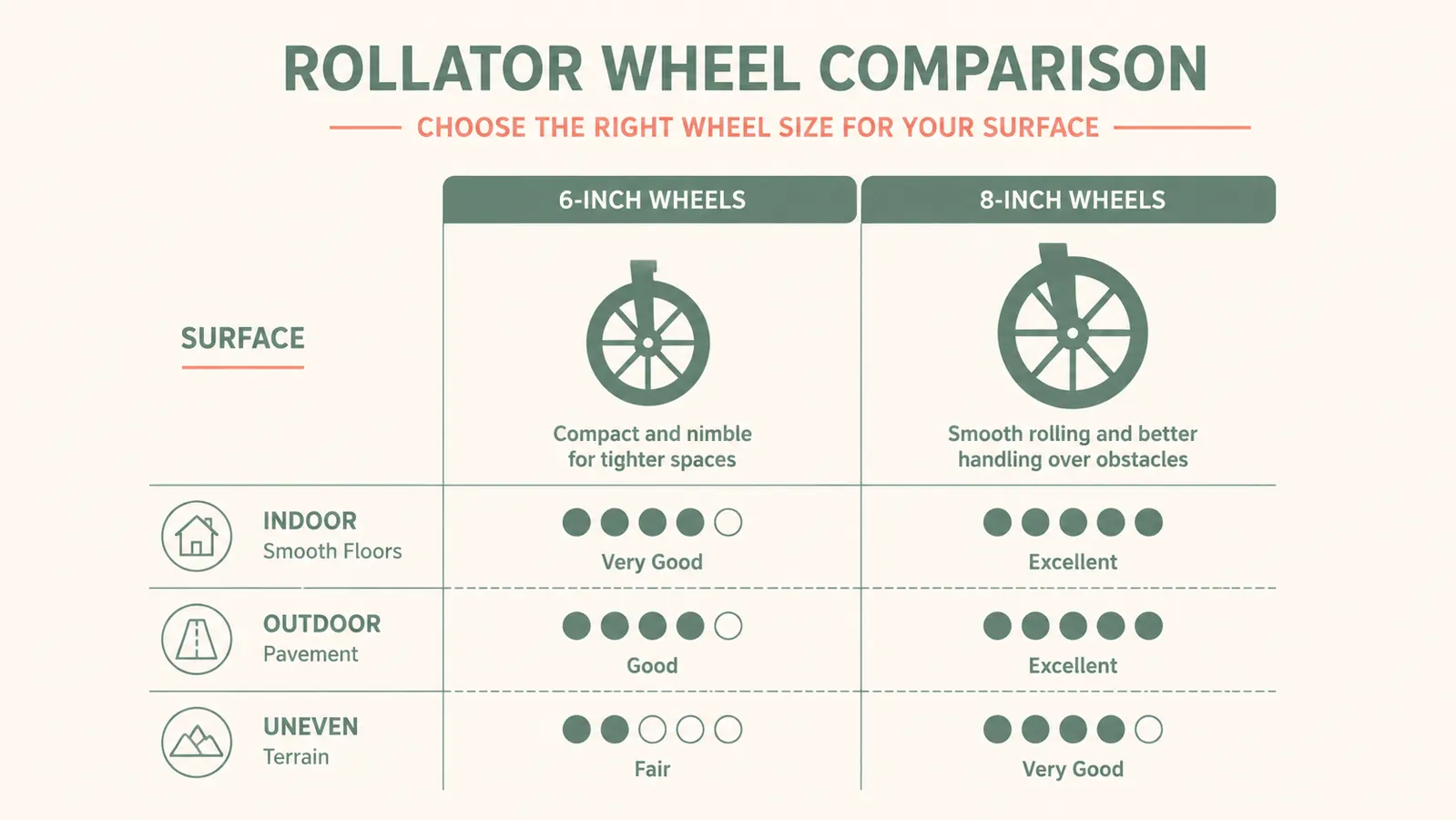
Rollator wheels come in 5-inch, 6-inch, and 8-inch diameters. The bigger the wheel, the better it handles outdoor terrain. The smaller the wheel, the more maneuverable it is indoors. Here is the honest breakdown I give to every caregiver who asks me.
If your parent primarily moves through their home, from the bedroom to the bathroom to the kitchen and back, a 5-inch or 6-inch wheel is ideal. It turns tightly in hallways, fits through standard 32-inch doorways without drama, and does not drag on thresholds or area rugs the way a bigger wheel can. The Drive Medical model uses 6-inch wheels, which I think is the sweet spot: still nimble inside the house, but capable of handling a smooth concrete sidewalk or a paved patio without rattling badly.
If your parent spends meaningful time outdoors on grass, gravel, or uneven pavement, consider an 8-inch wheel model. The larger diameter rolls over bumps instead of catching on them, and outdoor use is much less fatiguing. The tradeoff is that an 8-inch rollator is harder to spin around in a small bathroom. Think honestly about where your parent actually walks. For most people aging in a suburban home or an apartment, 6-inch wheels cover everything they will do.
Most people buy an 8-inch rollator thinking 'bigger is safer.' What they get is a walker that does not fit through the bathroom door.
Step 3: Set the Right Handle Height Before the Rollator Ships
Handle height is the most overlooked measurement and the most common reason a perfectly good rollator gets returned as 'uncomfortable.' When your parent stands upright with their arms relaxed at their sides, their wrists should be level with the handles. If the handles are too low, they will hunch forward trying to hold on. If the handles are too high, they cannot push down effectively and they will feel unstable. A forward hunch might not sound serious, but for someone who already has posture challenges or back pain, it causes real discomfort within an hour of use and makes them put the walker in the corner.
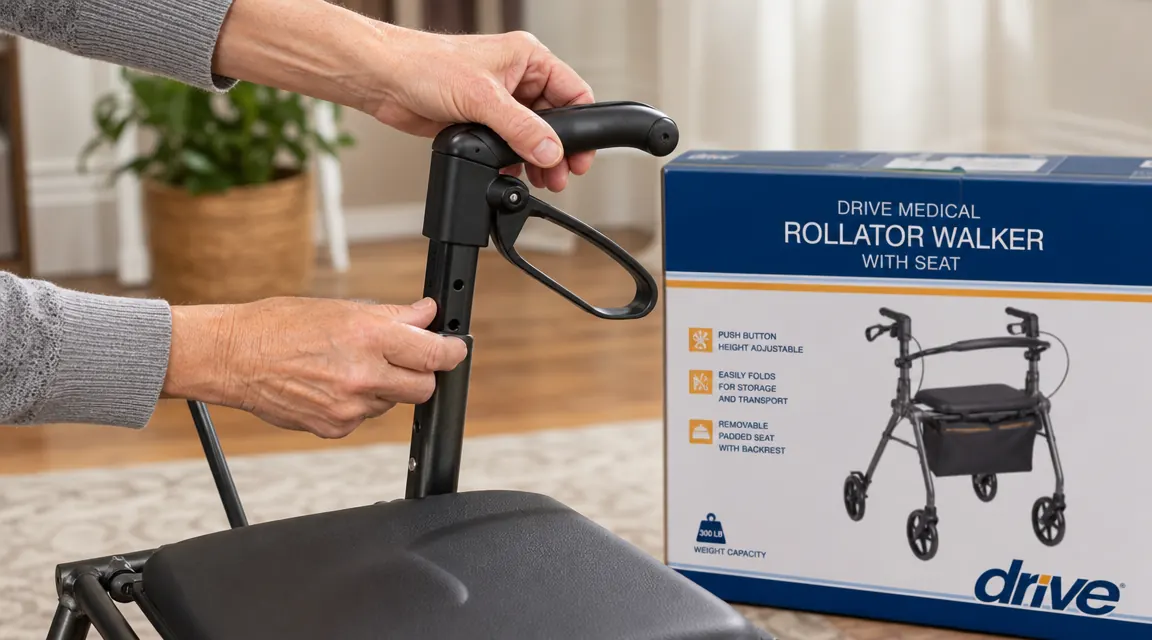
Measure your parent's wrist height from the floor in inches. The Drive Medical rollator adjusts from 32 inches to 37 inches, which covers most people between 5'0" and 6'1". Mom is 5'4" and her handles sit at 34 inches. That measurement took me thirty seconds to get before I ordered. Do it. It is the single easiest thing you can do to make sure the rollator gets used instead of parked.

Step 4: Understand Brake Types and Pick the Right One
Rollators use one of two brake systems: loop brakes or trigger brakes. The difference matters depending on your parent's hand strength and their primary reason for using the walker.
Loop brakes are the most common type. You squeeze the loop down toward the handle to engage the brake, and release to roll freely. They are intuitive for most people because the motion is similar to gripping a bicycle brake. The Drive Medical rollator uses loop brakes. If your parent has reasonable grip strength and wants a simple system, this works well. You can also lock the brakes in the down position so the walker stays fixed when someone is transferring to a chair or needs to rest on the built-in seat.
Trigger brakes require you to push a lever up to brake, which is the opposite of a loop brake. Some people find this less intuitive, but it is easier for people with limited grip strength or arthritis in the fingers, because the motion uses less force. If your parent has a diagnosed grip weakness, rheumatoid arthritis in their hands, or has had a stroke affecting one hand, ask their physical therapist which system they prefer before buying. Most PT clinics will have both types to test in the gym. If you do not have access to a PT recommendation, default to loop brakes. They work for the vast majority of users.
Step 5: Decide Whether the Built-In Seat Actually Changes Things for Your Parent
Every rollator has a padded seat, and most caregivers assume that is just a bonus feature. For some parents, it is the feature that determines whether they will agree to use the walker at all. Here is what I mean.
A lot of older adults resist walkers because walkers signal 'I cannot make it back.' The rollator's built-in seat removes that objection. Your parent can walk to the end of the hallway, sit, rest, then continue. They can stop at a store shelf without looking for a bench. They can manage their own fatigue without asking for help. This independence is not small. In our practice I have seen patients with mild COPD or heart failure who refused a standard walker but happily used a rollator because the seat gave them a perceived safety valve. The seat changes the psychology, not just the function.
Check the seat height while you are confirming handle height. A seat that is too low requires a lot of leg strength to stand from, which can be a problem for someone with weak knees or a recent hip replacement. The Drive Medical rollator has a padded seat that sits at about 19 to 20 inches from the floor when the handles are set to mid-range. That is a reasonable seated height for most adults, though if your parent is quite short, shorter seat heights can matter. Standard dining chair height is 17 to 19 inches, so this will feel familiar.
What Else Helps
Beyond the five steps, there are a few practical details that make a real difference in daily use. First, if your parent lives in a home with thick carpet or area rugs, test the rollator on those surfaces before relying on it. All rollators roll harder on carpet, and some parents avoid using the walker on carpeted floors out of frustration. Putting rubber glides on the rear legs of an indoor walker can help, but that is more of a standard walker trick. With a rollator, the wheel size and bearing quality matter more. The Drive Medical model rolls adequately on low-pile carpet; deep shag is harder for any rollator.
Second, think about storage. A rollator is larger than a cane and will sit in your parent's living space every day. The Drive Medical model folds for transport, but it does not collapse to a flat profile the way a transport chair does. It stores in a corner or in a car trunk. If your parent is in a very small apartment, measure the doorways and the bathroom before ordering. The frame width on most standard rollators is about 24 to 25 inches folded, which should clear a 32-inch doorway with room to spare.
Third, the basket underneath the seat is more useful than it looks. My mother keeps a small bag in the basket with her phone, a small notebook, and her afternoon medications. That basket quietly solved a problem I had not anticipated: she now walks to the kitchen to get things instead of asking someone else to bring them. That is exactly the kind of independence that keeps people mentally sharp and physically moving. Do not underestimate it.
The basket underneath the seat sounds minor. My mother has walked to the kitchen on her own every day for fourteen months partly because of it.
If you would like a deeper look at how this specific rollator holds up over time, I wrote a full fourteen-month review you can read here: Drive Medical Rollator Walker: What 14 Months of Daily Use Actually Taught Me. And if you are still weighing whether a rollator is the right choice versus a standard walker, this comparison breaks down the safety and independence differences honestly: Rollator Walker vs Standard Walker: A Caregiver's Side-by-Side Breakdown.
Ready to order? The Drive Medical Rollator is the one I point most caregivers toward.
It covers the five criteria above: 300-lb capacity, 6-inch wheels for indoor and light outdoor use, loop brakes, height-adjustable handles from 32 to 37 inches, padded seat, and a storage basket underneath. Over 50,000 customer reviews. Check today's price on Amazon.
Amazon Check Today's Price on Amazon →