
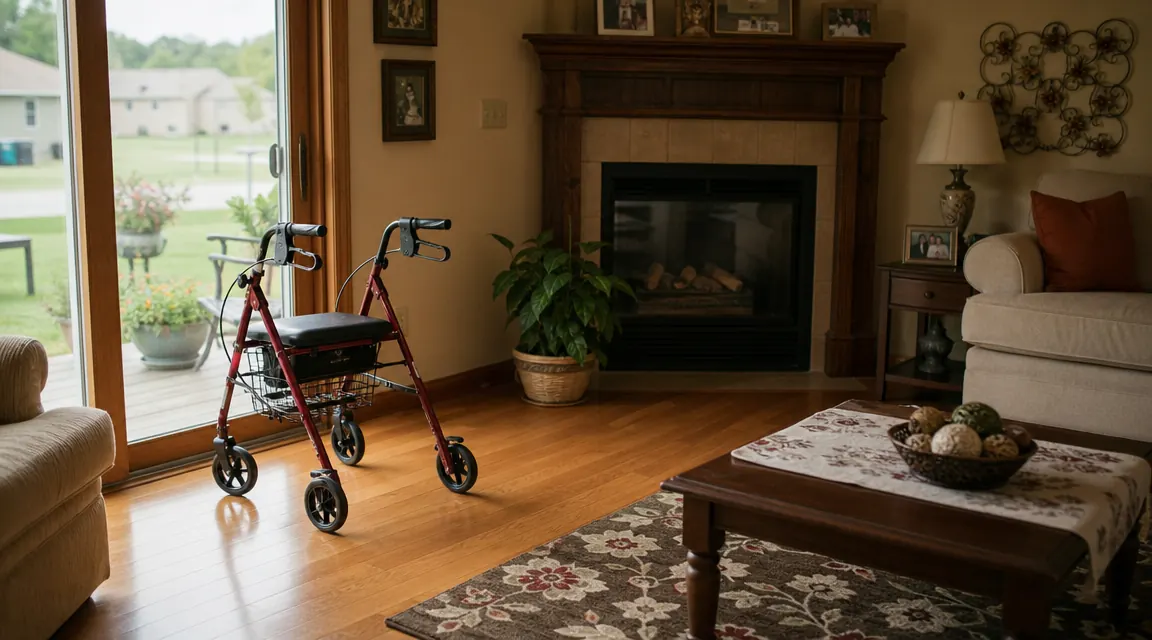
Let me tell you who reads the 50,000 reviews on this rollator. They are mostly people who already bought it, already love it, and wanted to share that love. That is not a knock on those reviewers. But it means the review pool is heavily skewed toward happy customers who had no problems. And the people who hit the assembly snag, or found the seat too firm for a bad hip, or discovered their parent needed something sturdier? A lot of them just returned it quietly without leaving a word. I have worked in medical offices for over two decades, and I have also been the caregiver putting products into my own mother's hands. I have seen what the reviews miss. This is what I think you should know before you click Add to Cart on the Drive Medical Rollator Walker.
To be clear: I am not here to talk you out of this walker. At under $80, with a 4.6-star rating across 50,000-plus buyers and genuine clinical endorsement from physical therapists nationwide, the Drive Medical rollator is a legitimately good product. But legitimately good and right for your parent are two different questions. My goal is to give you the nuance the product listing does not.
The Quick Verdict
The most proven rollator at its price point, with real caveats on seat comfort and a first-time assembly experience that catches buyers off guard.
Amazon Check Today's Price →Mom still needs one even after reading this? Here is today's price.
The Drive Medical Rollator is the right choice for most seniors with mild-to-moderate mobility challenges. If she fits the profile, get it sooner rather than later.
Amazon Check Today's Price on Amazon →How I Know What I Know About This Walker
I first encountered the Drive Medical rollator in a clinical context about seven years ago, when one of our physicians started recommending it by name to patients leaving our office after orthopedic consultations. At the time, I assumed it was just a decent product with good distributor relationships. Then I started seeing patients return for follow-ups genuinely doing better than expected on their stability goals, and I paid closer attention. The walker kept coming up.
Then my mother, Gloria, turned 79 and her balance started declining after a mild vertigo episode in late 2023. She is 5-foot-3, about 128 pounds, lives alone in a single-story house in Tampa, and is deeply private about anything that signals frailty to her neighbors. Selling her on any mobility aid was going to be a conversation. The Drive Medical rollator was one of three I evaluated before making a recommendation to her. She has been using it since early 2024. I have watched it in her home, on her patio, and in the parking lot of her Publix. What I am telling you here is not theoretical.
The Assembly Quirk Nobody Warns You About
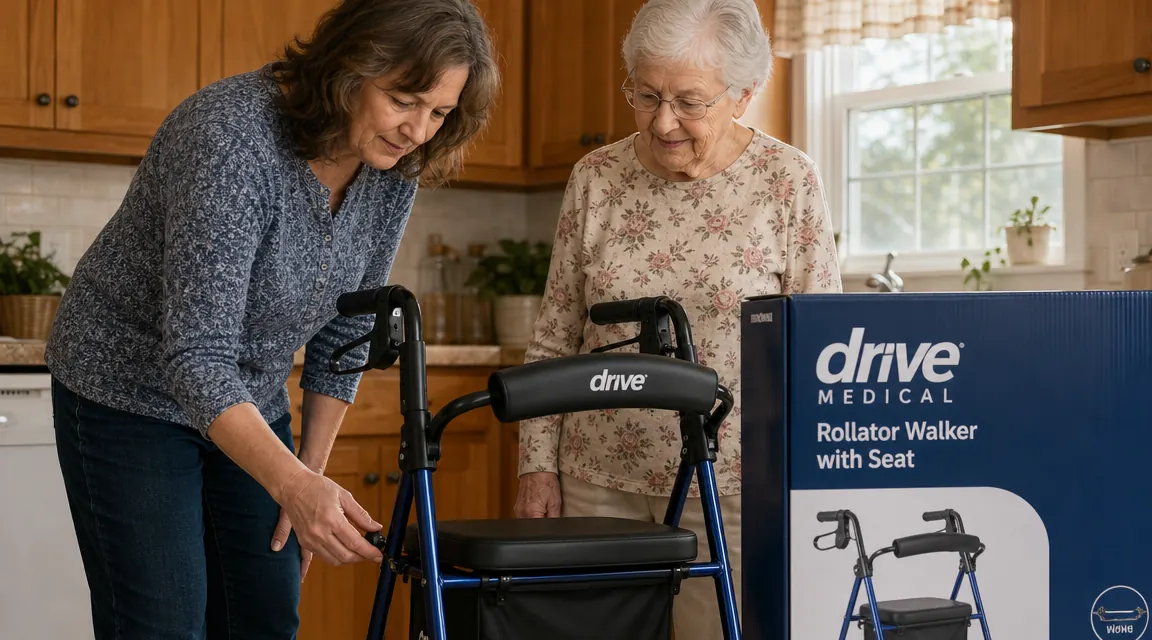
The Drive Medical rollator ships in a box that looks like it should take about 15 minutes to put together. For most people it does. But there is one step that trips a meaningful number of buyers, and it is not covered well in the included instructions: the front crossbar orientation.
The frame has a front crossbar that connects the two front leg sections. If you orient it backwards, the walker technically goes together and looks correct, but the brakes will not sit flush and the fold will feel stiff. You will spend 20 minutes wondering if you got a defective unit. You did not. The crossbar has a slight forward angle that should face toward the user, not away. If you look at the weld seam on the crossbar, it should face inward. The instructions show this in a small diagram that is easy to miss. Flip it around and everything clicks into place properly.
The second assembly note: the handlebar height is set by a spring-loaded push-button pin, not a tightening bolt. Pull the button out, push the leg section to the desired height, and the pin should click into one of the preset holes. If it feels like it is not locking, the leg section may be between holes. Adjust by half an inch in either direction. For most women in the 5-foot to 5-foot-6 range, the third hole from the bottom is the starting point. For men taller than 6 feet, this rollator may not adjust high enough, which I will come back to.
The crossbar goes in backwards more often than the instructions suggest. If your brakes feel uneven right out of the box, flip the crossbar before you call for a return.
The Seat Padding Question: What You Are Actually Getting
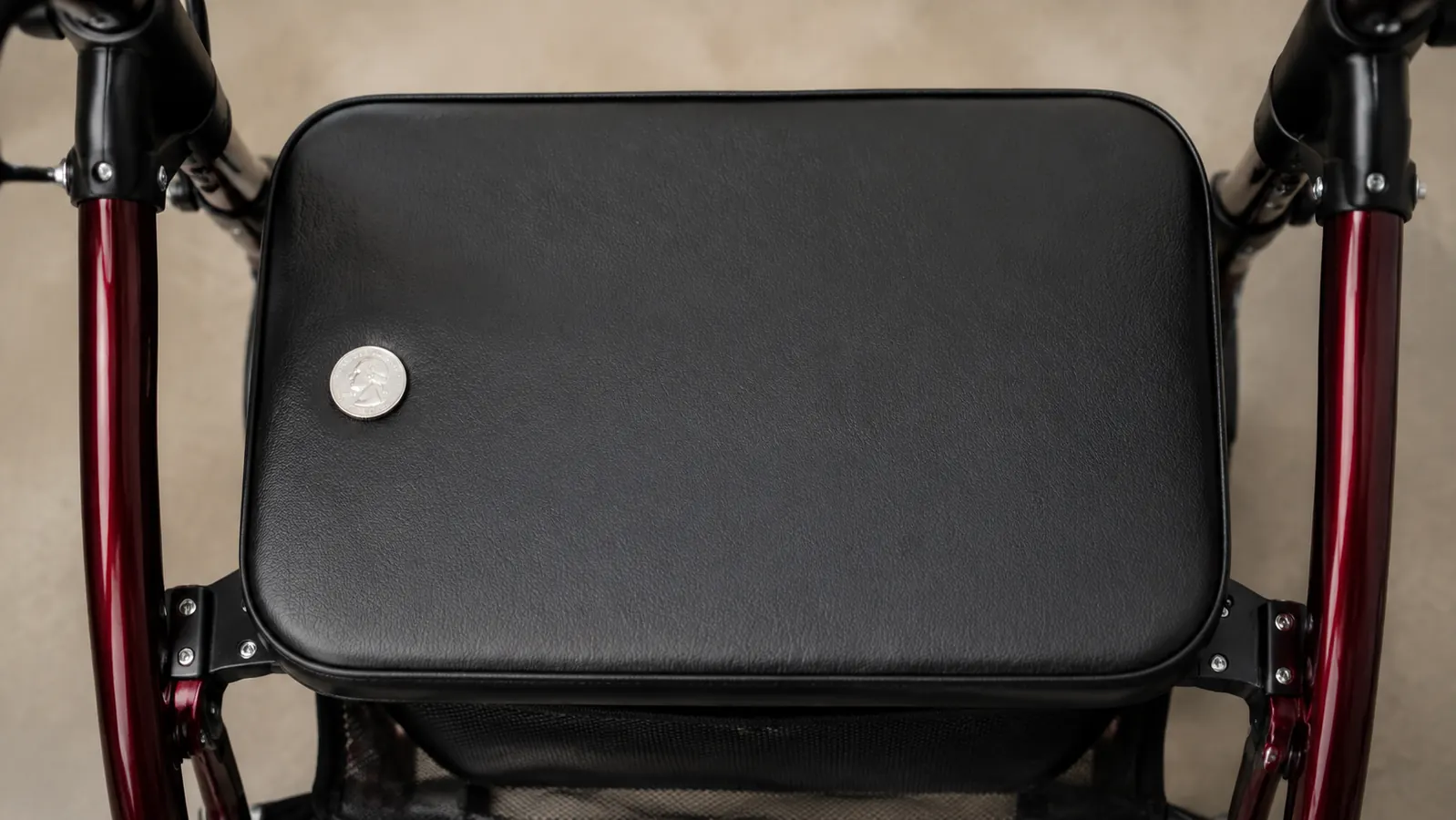
The Drive Medical rollator has a seat. That seat is frequently cited in positive reviews as a key feature. What those reviews sometimes do not say clearly is how thin that padding actually is. It is not a cushioned bench. It is a padded vinyl surface over a steel frame, and the padding is roughly a quarter inch thick. For a brief rest while standing in a checkout line, it is perfectly adequate. For someone with a hip replacement, a tailbone injury, or bony prominences from significant weight loss, it will be uncomfortable after about three minutes.
This is not a design flaw, exactly. A thicker cushion would add weight and bulk to a walker that succeeds partly because it is light and compact. But the marketing language around the seat, which tends to use words like 'comfortable' and 'padded,' sets expectations that the actual product does not fully meet for everyone. If your parent plans to use the seat frequently, for conversations at a farmer's market or long waits at a medical office, consider a separate adhesive foam seat pad. Several brands make them for under $15 and they attach without tools.
My mother keeps a thin non-slip cushion on hers that she bought at a discount store. It adds about a pound and makes the seat something she actually uses rather than avoids. This is worth knowing before you buy rather than after.
Performance in Real Conditions: Indoors, Outdoors, and Everything In Between
The Drive Medical rollator comes with 6-inch wheels. That is an important number. Six-inch wheels handle smooth flooring, low-pile carpet, and paved outdoor surfaces without drama. They start to struggle on grass, gravel, and any surface with a crack or lip above about a quarter inch. If your parent lives in an older home with threshold strips between rooms, check the height of those strips before you order. Most are fine. A few older homes have raised thresholds that will create a bump every time she crosses a room.
On hardwood and tile, the walker rolls well and quietly. On medium-pile carpet, there is some resistance, but it is manageable for most users. On the kind of thick cut-pile carpet common in older homes from the 1980s and 1990s, rolling requires noticeably more effort. If your parent's home has that kind of carpet throughout, a standard walker may actually be easier to maneuver, and I would point you toward my comparison of rollators versus standard walkers before you decide.
The brake cable is loop-style, which means pulling the brake handles upward locks the wheels. This is the standard design for this category. Some seniors with limited grip strength or arthritic hands find the squeeze-to-brake action tiring over a full day of use. Drive Medical also makes a model where pressing the brakes down locks and pushing handles forward unlocks, which can be easier for users whose hands tire quickly. If grip strength is already an issue, flag this before ordering the standard model.

The Under-Seat Bag: Surprisingly Useful, with One Caveat
The included under-seat bag is one of the less-discussed features that turns out to matter a lot in daily use. My mother carries her phone, her keys, a small water bottle, and a folded list in hers. For someone who previously needed to carry a purse while also managing a cane, the bag is a genuine upgrade in independence. She does not have to juggle or hang anything from a wrist.
The caveat is weight. The bag attaches below the seat and can hold up to several pounds, but loading it heavy shifts the rollator's center of gravity slightly forward. For a user who leans into the walker for balance, this is not usually a problem. For a user who is still learning to trust the walker and tends to pull back on it, extra bag weight can make the front wheels lift slightly on inclines. Keep the bag to light essentials until your parent has developed comfortable technique with the walker.
What I Liked
- 4.6 stars across 50,000-plus real buyers is genuinely rare , this thing earns its reputation
- Under $80 for a product physical therapists actively recommend by name
- Folds compactly for car trips, closets, and tight apartment storage
- Under-seat bag adds real daily independence, especially for solo seniors
- Lightweight steel frame is easy for older adults to lift and reposition
- Height adjustable across a wide range, fits most adults 5 feet to 6 feet tall
Where It Falls Short
- Seat padding is thin , not designed for extended sitting; a separate cushion costs extra
- Assembly crossbar orientation is easy to get wrong and the instructions are not clear
- 6-inch wheels struggle on thick carpet, grass, and gravel
- Not appropriate for users who need to lean heavily on the walker for weight support
- May not adjust high enough for users taller than 6 feet
- Grip-style brakes can fatigue arthritic hands over a full day
Who Should Actually Skip This Model
I am going to be specific here, because vague advice wastes your time and your parent's safety. Skip the Drive Medical standard rollator, at least this model, if any of the following apply.
Your parent uses the walker for partial weight bearing after a hip or knee surgery. Rollators are designed for balance assistance, not weight transfer. If a physical therapist or physician has used the phrase 'partial weight bearing' or 'weight bearing as tolerated,' ask that provider specifically whether a rollator is appropriate. Many post-surgical patients do better on a standard walker initially and transition to a rollator later.
Your parent is taller than 6 feet or shorter than 4-foot-11. The height range on this model does not accommodate either extreme well. Drive Medical makes a tall version for users over 6 feet. For very petite seniors, a pediatric or bariatric variant may be a better fit depending on their build.
Your parent lives primarily on thick carpet or in a home with significant threshold lips, unlevel transitions, or an outdoor path of gravel or grass. The 6-inch wheels will frustrate rather than help. An 8-inch wheel rollator, or a heavy-duty model, would serve better. If the primary use is the great outdoors, this is not the right walker.
Your parent has significant cognitive decline and has trouble learning new routines. Rollators require the user to understand brake locking before sitting, to never sit down while the brakes are off, and to manage the height of the seat relative to their own height. These are learnable habits for most people, but they require a few days of supervised use. If cognitive engagement is already a concern, a standard walker with no moving parts may be safer.

Who This Is For
This rollator is genuinely excellent for the senior who is still mostly independent, has mild to moderate balance decline, lives on smooth to medium-texture flooring, and wants a mobility aid that does not feel like a hospital prop. My mother falls squarely into this category. She uses hers every day, takes it to her weekly card group, and stores it folded in her car for shopping trips. She bought a cushion for the seat, we took 20 minutes to assemble it correctly, and it has worked without a single problem since early 2024.
If your parent is in the 5-foot to 6-foot range, is recovering from balance issues rather than major surgery, and lives on standard flooring, this is almost certainly the right walker at the right price. There are more expensive rollators, and a few of them offer genuinely better features. But none of them offer this level of reliability for under $80, and none of them come with this much real-world evidence that they hold up. For most families reading this, the Drive Medical rollator is the correct answer.
Who Should Skip It
To recap cleanly: skip this specific model if your parent needs weight-bearing support after surgery, is taller than 6 feet or shorter than 4-foot-11, lives primarily on thick carpet or outdoor terrain, or has significant cognitive challenges with learning new physical routines. In any of those cases, the right product exists, it is just not this one.
If she fits the profile, today is the right day to order.
The Drive Medical Rollator is in stock, ships fast, and is the same product physical therapists have been recommending for years. Check the current price before it changes.
Amazon Check Today's Price on Amazon →